



- Home
- >
- News
- >
- Food Forming Machine
- >
Food Forming Machine
2026-11-19 15:44Food Forming Machine: One Head, Four Shapes, and What Changes Between Them
A food forming machine does one thing: it takes ground or diced protein and presses it into a shape. Everything else — patty, nugget, meatball, cutlet — is the same process with a different mould plate and a different knock-out.
That is why buyers who shop by product name end up confused. A machine sold as a "burger patty former" and one sold as a "meatball forming machine" are often the same frame with different tooling, and the decision that matters is not the shape on the box but the plate, the fill pressure and the belt.
This page is the index to everything we publish on forming: how the machine works, what the spec sheet means, and which of the detailed pages to read next.
How a Forming Machine Actually Works
Product drops into a hopper and is pushed by a feed screw or a piston into a rotating or reciprocating mould plate. The plate has cavities cut to the shape of the finished item; the cavity volume sets the portion size. A knock-out then pushes the formed item out of the cavity onto a conveyor, and the plate returns empty for the next fill.
Three consequences follow:
Portion size is a volume, not a weight. Weight follows from volume and density, which is why the same plate produces a heavier patty from a colder, denser mix.
Shape is tooling. Changing from a round patty to a star-shaped nugget is a plate change, not a machine change.
Speed is a frequency. The plate cycles a fixed number of times per minute; output is cycles × cavities, less the losses.
The standard machine in our range, the DHCB240-Ⅲ, runs at 25–35 cycles per minute on a 240 mm belt, which is why output is always quoted as a range rather than a number.
The Spec Sheet, Read Properly
| Parameter | Value | What it decides |
|---|---|---|
| Model | DHCB240-Ⅲ | — |
| Input voltage | 380 V / 50 Hz | Site power; export builds are configured per destination |
| Installed capacity | 0.2 kW | Low because the work is done by air and mechanics, not a big motor |
| Conveyor belt width | 240 mm | Widest product row per cycle |
| Belt speed | 3–15 m/min | How fast product leaves; must match the next machine |
| Working frequency | 25–35 times/min | Cycles per minute — the throughput driver |
| Compressed air | 1.2 m³/min | A real utility requirement, often forgotten until commissioning |
| Filling area | 200 × 140 mm | The usable plate area for cavities |
| Outfeed height | 700–850 mm | Must match the machine downstream |
| Dimensions | 2100 × 600 × 1750 mm | Floor space and access for plate changes |
Note the 1.2 m³/min of compressed air. A forming machine is sold as an electric machine and then fails at commissioning because the plant's compressor cannot sustain the air demand alongside the rest of the line.
Four Shapes, One Head
The plate decides the shape and the knock-out decides how it leaves.
Patty. A round or oval cavity, a flat knock-out, and a belt that carries the patty away without folding it. This is the most common configuration and the one most plants start with.
Nugget. An irregular cavity, and usually a shorter drop onto the belt so the shape survives. Nuggets are formed at the same speed as patties but weigh less, so the same machine produces fewer kilos per hour.
Meatball. A deeper, roughly spherical cavity. The difficulty is not forming the ball but getting it off the plate without flattening one side, which is why the knock-out and the belt speed have to be matched to the cavity depth.
Flattened cutlet. A wide, shallow cavity — the same head, a plate that spreads rather than deepens.
The mould is the consumable that decides your product range, so the number of plates quoted at purchase matters more than the machine's headline speed.
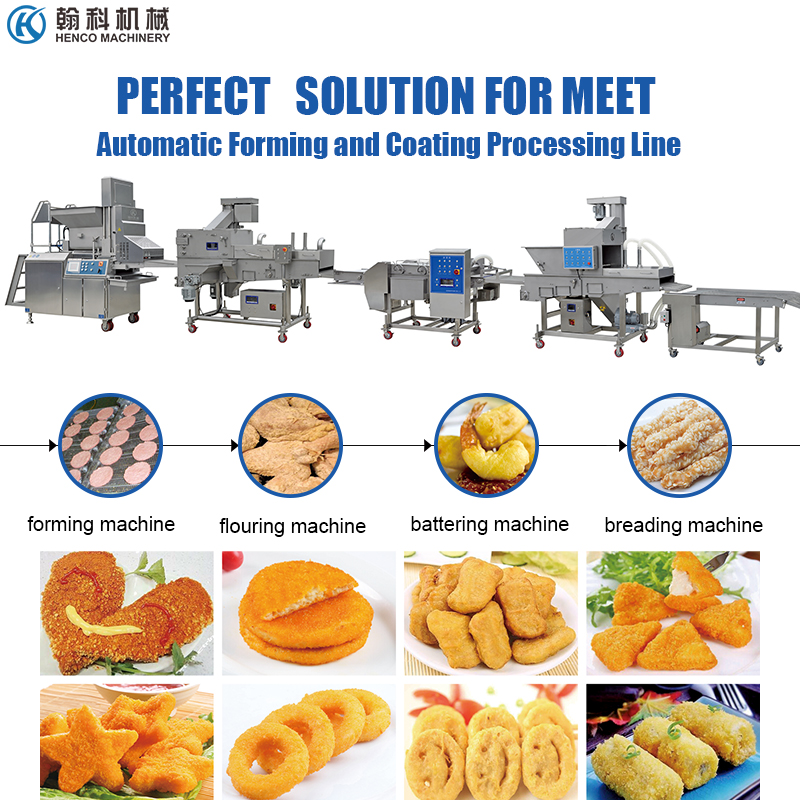
The same head feeding a flour, batter and bread line: the plate decides the shape, the line decides the finish.
What Decides Portion Accuracy
Four things, in order of how often they cause trouble:
Product temperature. A mix that is too warm flows and overfills the cavity; too cold and it does not fill the corners. The window is narrow and the machine cannot compensate for it.
Fill pressure. Set on the machine, but it only works if the mix is consistent from batch to batch.
Plate wear. Cavities erode at the edges over millions of cycles, and portion weight drifts upward as they do. Plate replacement is a maintenance item, not a fault.
Air supply stability. A pressure drop mid-shift shows up as under-filled portions, which look like a plate problem and are not.
Where It Sits in a Line
A former is almost never sold alone. Downstream it feeds a flouring machine, a battering machine and a breading machine, then frying or freezing, and finally a stacker that takes formed product off the freezer belt.
That sequence is what the automatic forming and coating line and the burger patty and chicken nugget process line are built from, and the patty stacker is the unit at the far end.
The practical constraint is belt height. A former that discharges at 850 mm into a fryer that takes product at 950 mm needs a conveyor in between, and that conveyor is a line item nobody budgets for.
Five Questions Before Ordering
How many plates, and at what cost? One plate per shape, and the spare plate is what keeps the line running when the first one wears.
What is the changeover time between plates? Quoted in minutes, not "quick".
What product temperature does the machine expect? Then check the plant can hold it.
What air supply is available? Compare against the 1.2 m³/min figure, not against the compressor's headline output.
What height does the next machine take product at? Decide the conveyor before the order, not after.
The Forming Cluster: Where to Read Next
This page is the hub. The detailed pages sit below it:
Machine types — the 240 type and the 100 type cover the two standard frames; the automatic patty forming machine is the line-integrated version.
The full range — food forming machines lists every model with its plate options.
How the machine is built — the structural principle of the meatloaf forming machine explains the mechanics from the inside.
Worked cases — a Turkish patty test, Dutch customers testing the former and a Thai customer visit each show the machine running on a different product.
Nuggets specifically — the chicken nugget battering and breading line case follows one product end to end.