



Meat Dicing Machine Guide
2026-11-18 13:45Meat Dicing Machine: What Decides the Cube, and What the Spec Sheet Leaves Out
A meat dicing machine makes two cuts, not one. The first cut slices the product into strips; the second cuts across those strips to make cubes. Almost every dicing problem in a plant traces back to the second cut — and almost nothing on a spec sheet tells you whether it will work.
This is what actually decides the cube: the geometry of the cutting head, the temperature of the product, and the speed the belt runs.
What the Machine Does Between the Two Cuts
Product enters on a belt and is pressed into the cutting head by a holding device — a set of claws or a press plate — so that it cannot lift or slide while the blade passes through it. That pressure is the difference between a cube and a crushed piece.
The cross-cut blade then travels across the belt and divides the strip into lengths; a set of longitudinal blades divides the strip into widths. The order sounds trivial and is not: if the product moves even slightly during the cross cut, the second dimension is no longer square, and the cube becomes a wedge.
On the fresh-meat line we build, this is handled by a knife press claw that holds the product against the blade group so that strips and cubes come out with square edges rather than torn ones. On the frozen dicing machine, the same job is done by the rigidity of the frozen block itself — which is why temperature matters more there than any adjustment.
The Spec Sheet, Read Properly
The frozen meat dicing machine, model HKDQJ300-VII, is a useful example of what the numbers mean:
| Parameter | Value | What it decides |
|---|---|---|
| Belt width | 300 mm | The widest product that can enter |
| Belt speed | 3–18 m/min | Throughput, and how hard the blade bites |
| Max. cutting width | 300 mm | The widest cube row per pass |
| Cutting thickness | 5–30 mm | The smallest and largest cube dimension |
| Production capacity | 500–1000 kg/h | A range, not a guarantee — see below |
| Power | 2.2 kW | Blade torque under load |
| Overall dimension | 2080 × 1040 × 1450 mm | Floor space, and ceiling for loading |
Read the belt speed and the cutting thickness together. They are the two numbers the operator will actually change, and they interact: at the top of the speed range with the thickest cut, the machine is working at its hardest, and the capacity figure sits at the bottom of its range rather than the top.
Three Numbers That Decide the Cube
The cross-cut pitch — the distance between blade passes, which sets one dimension of the cube.
The longitudinal spacing — set by the blade set, which fixes the width.
The cutting thickness — the third dimension, adjusted on the head.
A change of cube size therefore means a change of blade set, not a turn of a dial. That is the single most under-planned part of a dicing purchase: a plant that needs three cube sizes needs three blade sets, and the changeover time between them should be quoted before the order.
Blade material matters here too. On the fresh-meat line the blades are 191 mm SUS420J2 stainless at 1 mm thickness, and the service life is quoted in tonnage of raw material rather than in hours — because hours mean nothing if the product is tough.
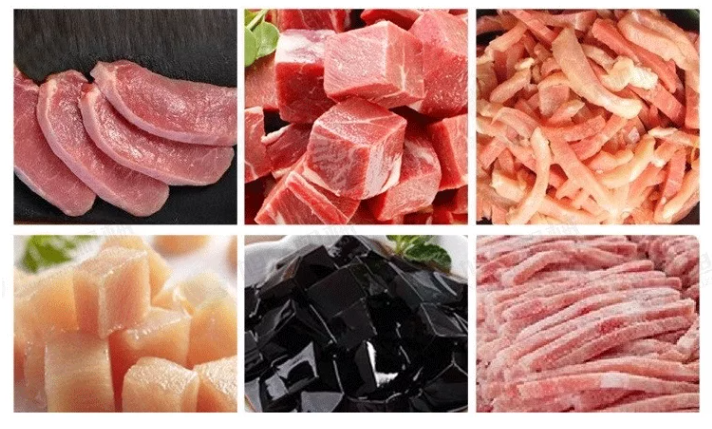
The same head, three blade sets: cubes, strips and slices.
Temperature Decides More Than the Blade
Frozen and fresh are two different machines for a reason.
A frozen block holds its shape under the blade, so the cut is clean and the cube stays square — but the block has to be cold enough to be rigid, and too cold makes the blade work like a saw through ice. A fresh product is soft; it needs pressure to hold it and a colder product temperature than most operators expect, or the cube smears instead of cutting.
Which is why the question "can one machine do both" usually gets the answer "badly". The knife geometry, the holding device and the belt speed are all set for one condition.
Why Capacity Is a Range
The 500–1000 kg/h figure is not a marketing range. It is what the machine does across the cube sizes and belt speeds it is designed for.
A larger cube weighs more per cut and produces more kilos per hour at the same belt speed; a small cube at high belt speed can produce the same tonnage with a very different cut quality. When a supplier quotes a single number, ask which cube size it refers to — the answer is usually the largest one.
Where Dicing Sits in a Line
Dicing is rarely the first or the last step. Upstream there is portioning or block forming; downstream there is packing, and often freezing before packing so the cubes do not deform in the bag.
That position matters for two decisions: the dicing machine's belt height has to match the machine feeding it, and the product has to arrive at the right temperature. Both are layout questions before they are equipment questions, which is why they belong in the room-by-room plant plan rather than in the machine quotation.
The two products this applies to are the frozen meat dicing machine and the single-channel fresh meat dice process line. A worked example of the fresh line in a specific trade is in the barbecue industry note.
What to Specify Before Ordering
The cube dimensions — all three, with the tolerance you will accept.
The product temperature at the moment of cutting — not the temperature in the cold store.
The output per shift, in kilos, including changeover and cleaning.
The number of cube sizes you will actually run, and how often you change between them.
The belt height of the machine upstream, so the two line up without a new conveyor.
Blade sets, voltages and the drawing are one specification, not three. The OEM and ODM service page covers what changes when a dicing machine is built to a private label rather than to our standard build.