



Turkish Patty Forming Test
2026-10-13 17:55Turkish Customer Tests a 100-Type Patty Forming Machine at Our Jinan Factory
In October 2026 a customer from Turkey visited our factory in Jinan to run a 100-type patty forming machine before the machine is packed and shipped. The purpose of the visit was straightforward: to see the machine working on real product, rather than judging it from a specification sheet.
A patty forming machine is only as good as what comes off the end of its conveyor. Weight, shape and surface all depend on the product going in — its temperature, its fat and moisture content, and how it has been prepared. That is why buyers who are serious about a line ask to run it themselves before the order is finalised, and why we keep machines assembled and working on the factory floor for exactly this purpose.
Why a Trial Run Beats a Specification Sheet
Published figures tell you what a machine can do under the manufacturer's conditions. A trial tells you what it will do under yours. Two processors can run the same former with the same setting and get different results, because the product is different: a colder mix is stiffer and holds shape differently, a coarser grind feeds unevenly, and a higher fat content releases moisture that changes how the patty releases from the forming plate.
None of that appears on a datasheet. It appears on the conveyor, within the first few minutes of running product.
What Happened During the Visit
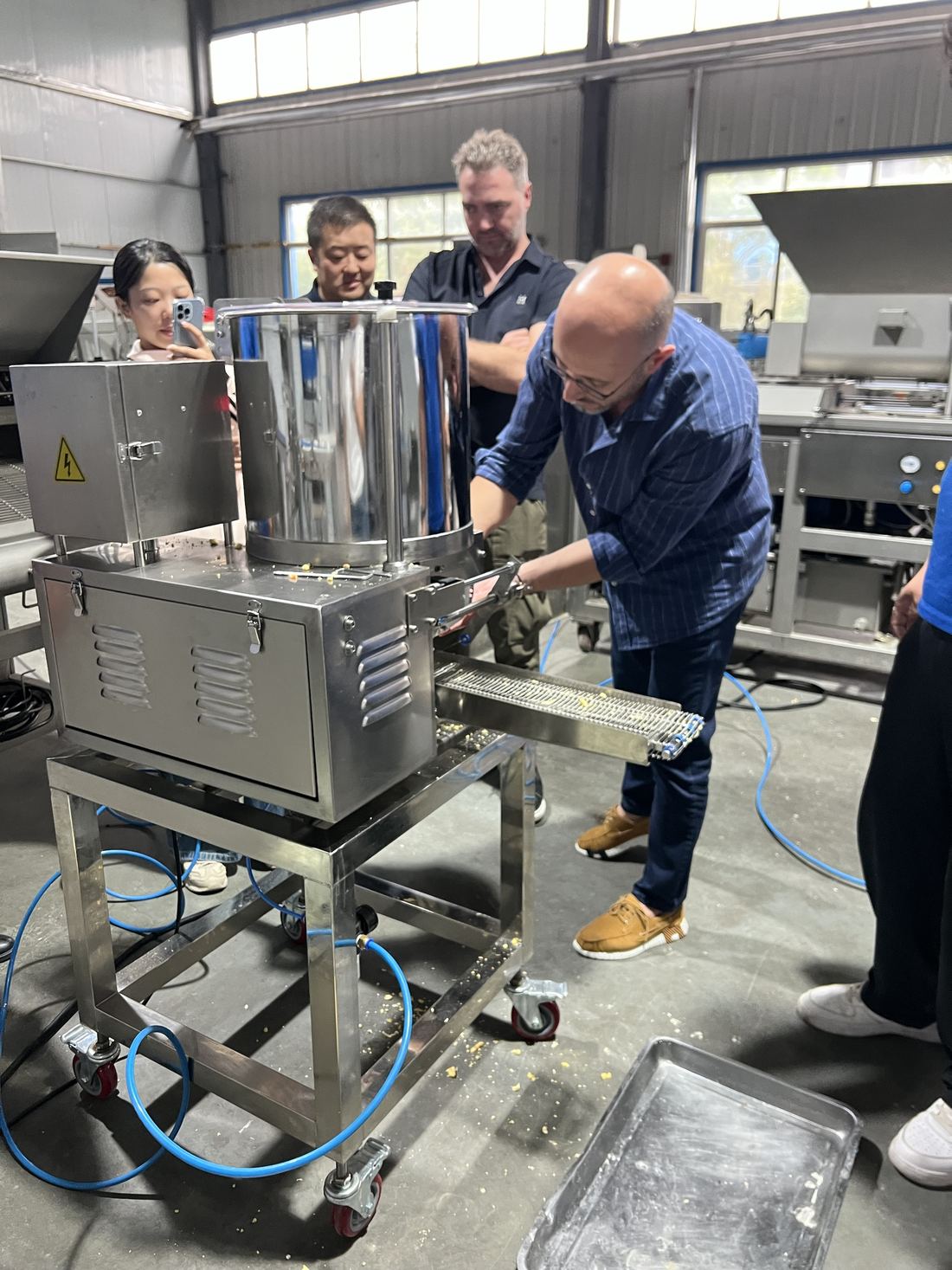
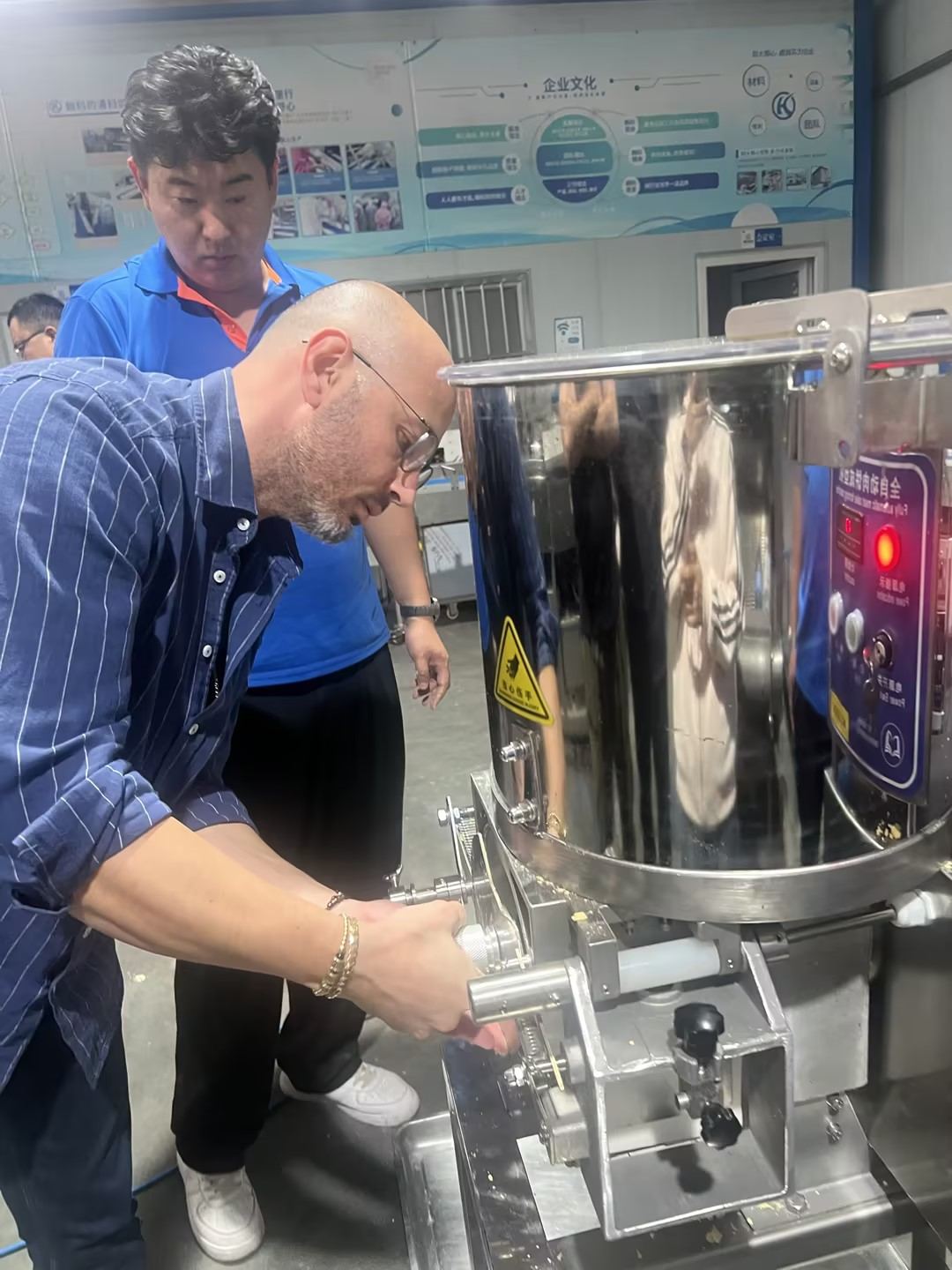
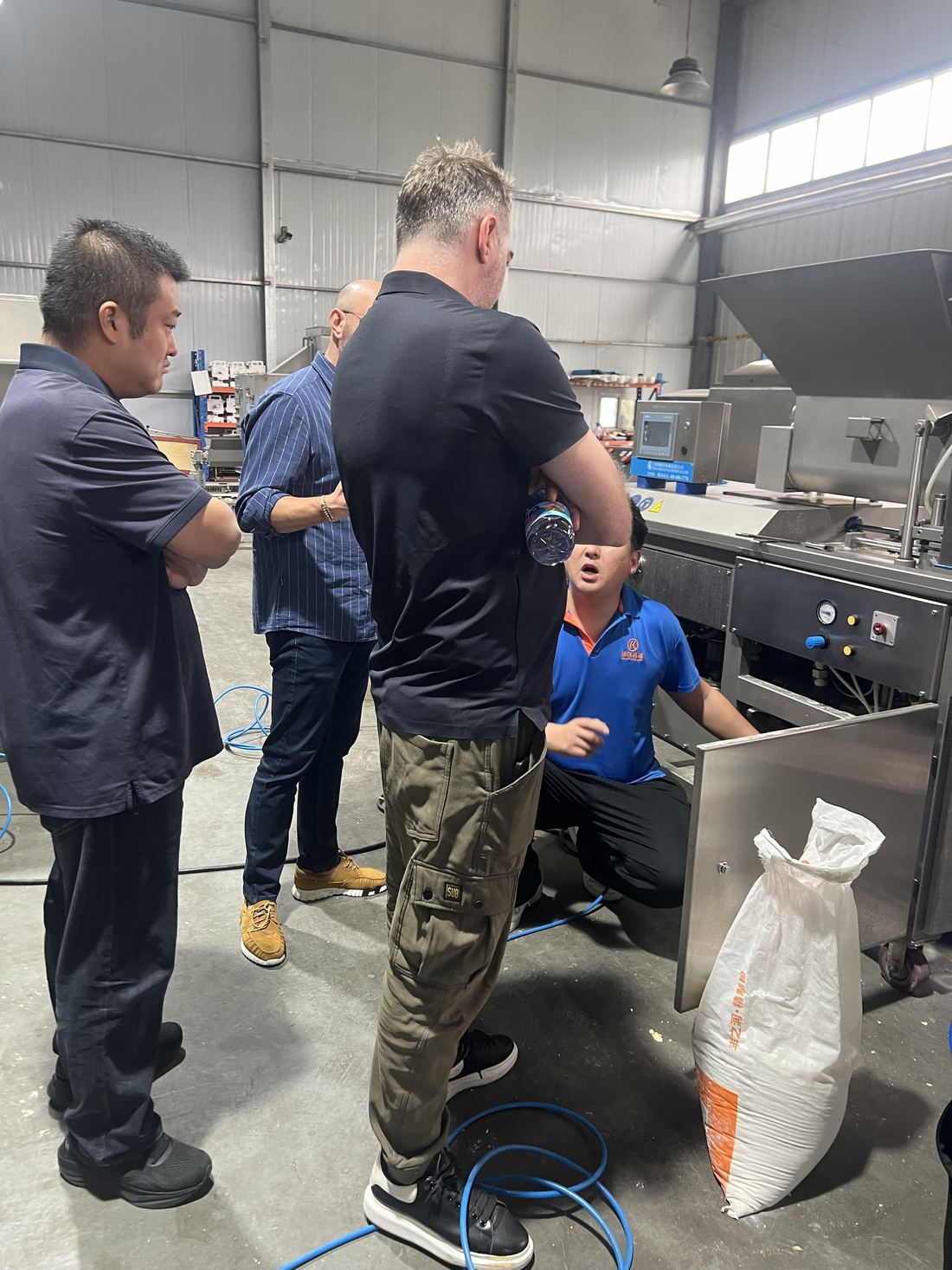
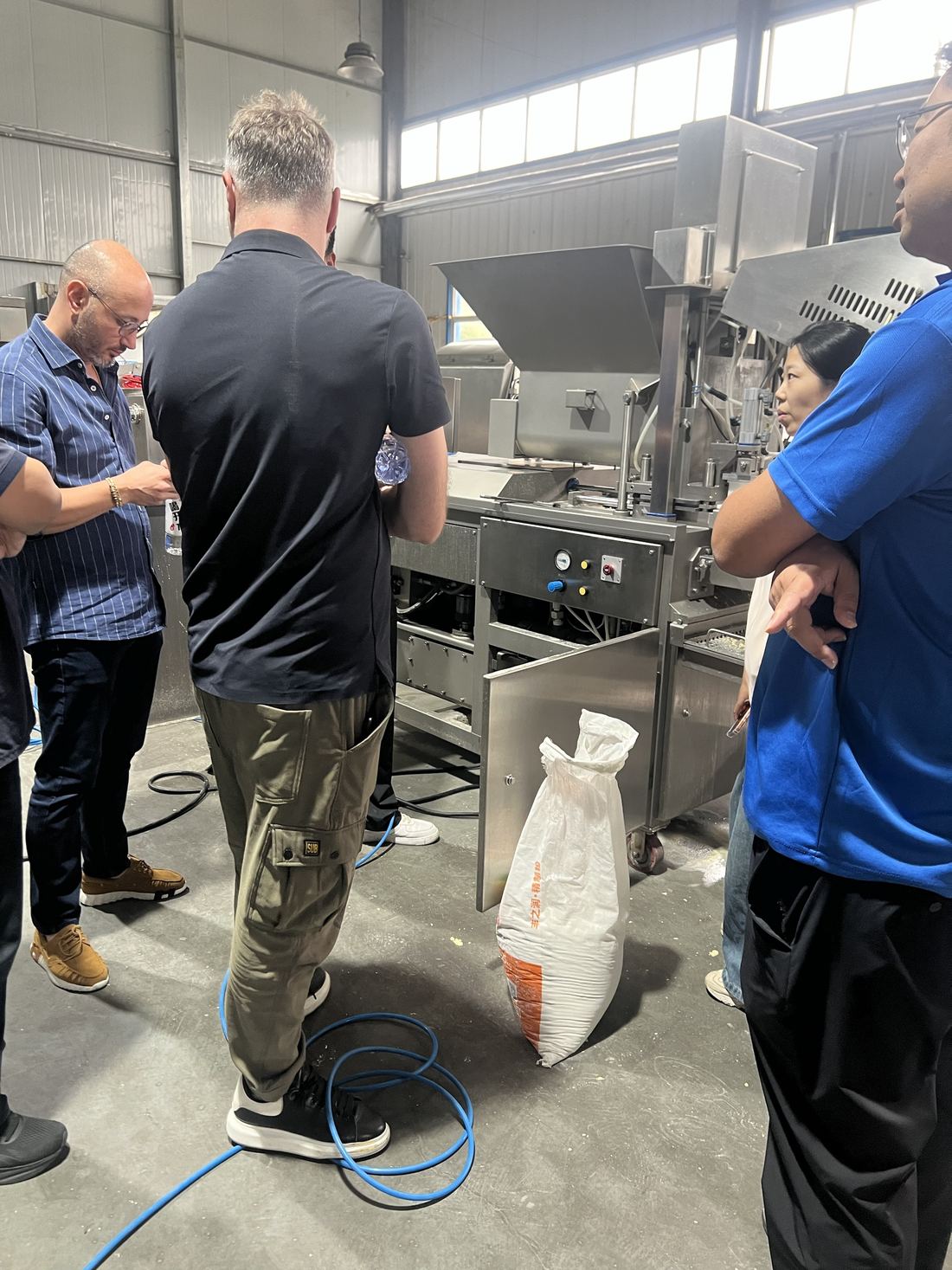
The machine was set up and run with patty production in mind, and the customer worked on it directly. Between runs the forming head was adjusted and the machine re-started, so that the difference in output could be judged sample against sample rather than in the abstract — the visitor is at the machine with his hands on the adjustment, while our engineers and the rest of his group watch the conveyor.
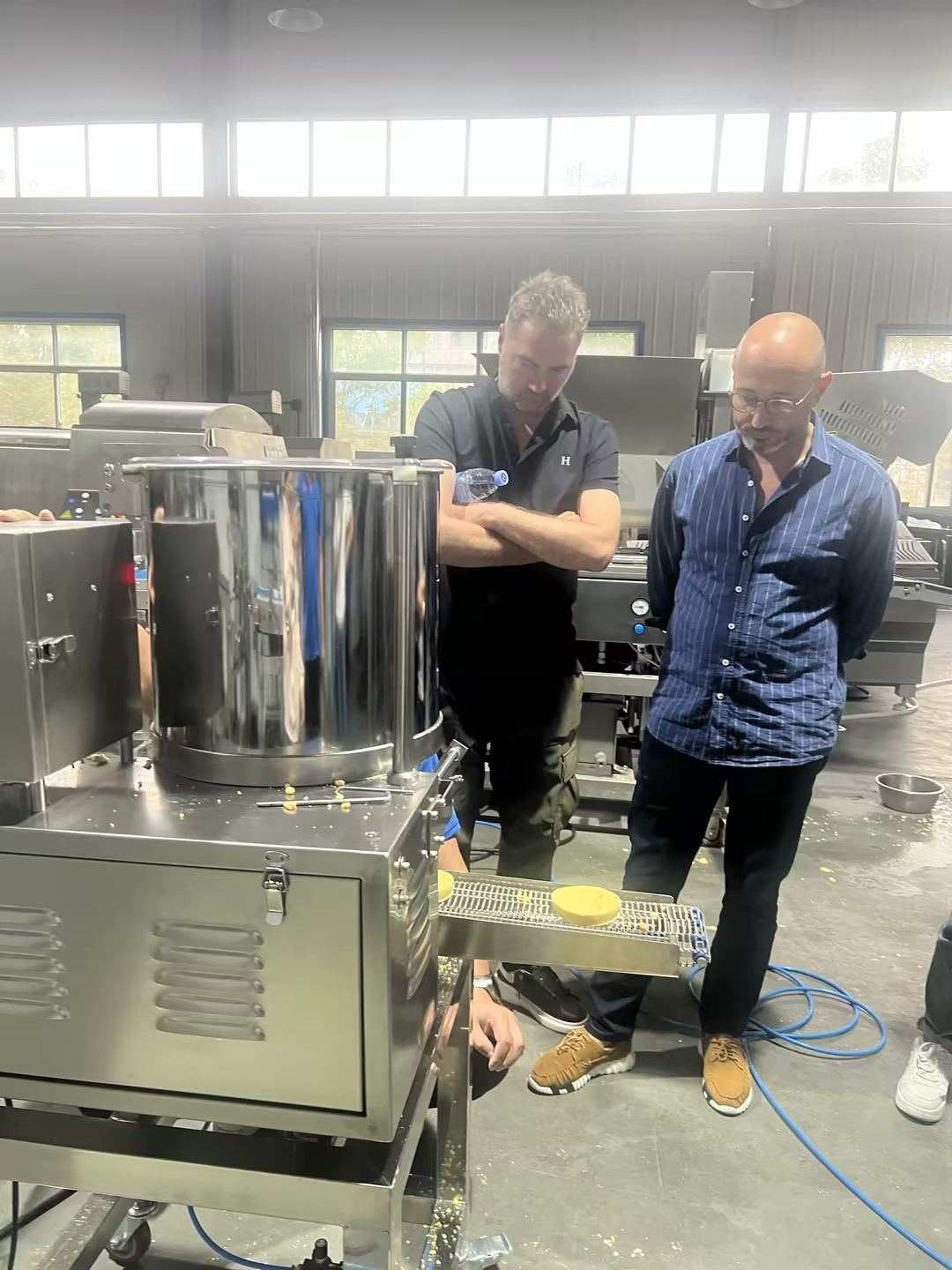
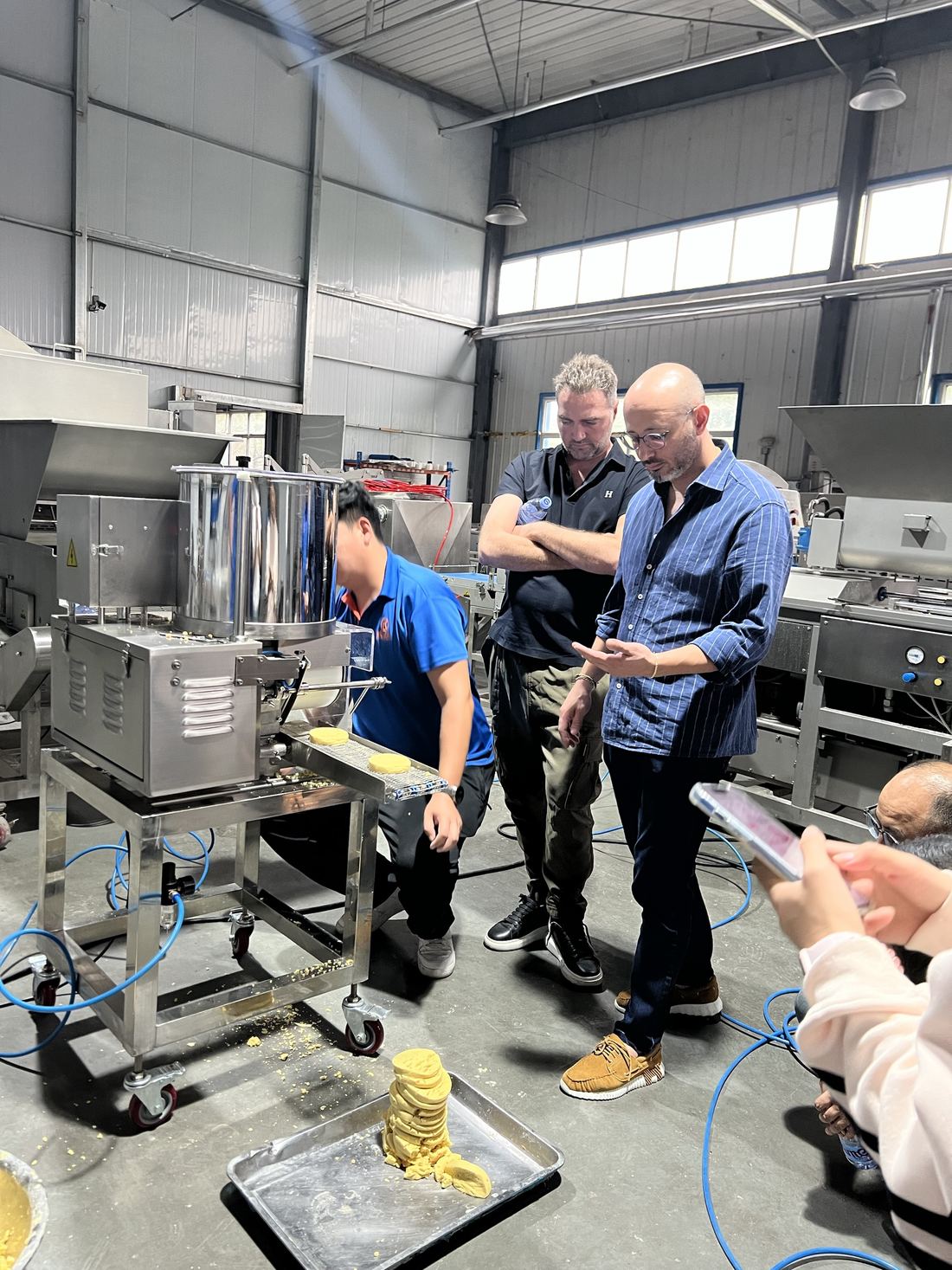
Formed patties were taken off the outfeed conveyor and collected on trays as they came, so that weight and shape could be checked as a batch rather than as a single good sample.
What Was Checked
- Weight consistency. Patties were weighed across the run, not just once — the question is not whether the machine can hit the target weight, but how far it drifts over a shift.
- Shape and release. Whether the patty leaves the forming plate cleanly and holds its edge, which is where a product that is too warm or too wet shows up first.
- Diameter and thickness. Both are set by the forming plate and the barrel, and both have to match what the customer's packaging and cooking process expect.
- Changeover. How long it takes to change the forming plate or the product barrel, because on a plant running more than one product this is daily labour, not a one-off task.
- Transfer to the next machine. How the product leaves the conveyor and meets the breading machine, since a patty that arrives damaged at the coating stage cannot be recovered later.
- Throughput against the shift. Comparing the running rate against the output the customer needs per shift, at their shift length rather than at a peak minute.
- Cleaning and strip-down. How the guards, conveyor and forming head come apart, and whether it can be done without tools.
The 100-Type Forming Machine
The machine on test is a compact piston-type former: product is loaded into a cylindrical barrel, pushed through a rotary forming head under compressed air, and carried away on a mesh outfeed conveyor. The whole unit sits on an open stainless frame with castors, which is what makes it practical to move between rooms in a plant that produces more than one product.
For the 100-type machine in the HK-RBJ-1500 configuration, the published figures are: formed diameter 100 mm, output 2,100 pcs/h, power 0.55 kW at 380 V, body 860 × 600 × 1,500 mm, machine weight 105 kg, conveyor belt width 130 mm, product thickness adjustable between 6 and 16 mm, product barrel 360 × 360 mm and conveyor capacity 30 L. Weight error is quoted as controllable within 1 g on the 100-type series.
Shape is not limited to a plain round patty. The 100-type patty forming machine can be supplied with forming plates made by CNC to a template, so round, square, heart, triangular and other geometric shapes can be produced on the same machine — useful for a processor selling into more than one retail format. The full range sits under food forming machines.
Forming and Coating in the Same Visit
Because a formed patty usually goes straight into a coating stage, the same visit also covered the breading machine. With the lower panels open, the belt and the crumb path could be examined directly rather than described, and the customer could see where crumb is recovered and where it is lost — on a breaded line, crumb loss is a real cost per tonne of finished product.
For customers building a whole process rather than replacing one machine, forming and coating are normally specified together as a line; the combination is described under our food processing lines, and the forming and battering stage is also available as a single supplied unit in the forming and battering process line.
Trials of this kind are routinely arranged for customers from the countries we already supply, and a similar visit by a customer from the Netherlands is documented on this site, where visitors ran a forming machine before buying: Dutch customers test food forming machine at Henco Machinery. If you are specifying a broader line, our guide to meat processing equipment explains how the stages fit together.
Frequently Asked Questions
Can I test a patty forming machine with my own product before buying?
Yes. Trials are run on the factory floor with the machine assembled and working, so that the product is tested on the machine itself rather than judged from a specification sheet. Any change to the forming plate, barrel or weight setting can then be made while the machine is still with us.
What decides the weight consistency of formed patties?
Weight consistency depends on the forming plate, the feed pressure and the product itself — its temperature, fat content and how evenly it has been prepared. A colder or more uniform mix feeds more consistently, and weight error is quoted as controllable within 1 g on the 100-type series.
What diameter and thickness can a 100-type forming machine produce?
In the HK-RBJ-1500 configuration the formed diameter is 100 mm and product thickness is adjustable between 6 and 16 mm, using the forming plate and barrel supplied for that product.
Can the forming machine produce shapes other than round?
Yes. Forming plates can be made by CNC to a template, so round, square, heart, triangular and other geometric shapes can be produced on the same machine.
What output can a 100-type forming machine reach?
The published output for the HK-RBJ-1500 configuration is 2,100 pieces per hour. The rate that matters commercially is the one your line sustains across a full shift, with the machine running on your product.
How do I arrange a trial run at the factory?
Tell us the product, the target weight, the diameter and thickness you need, and the output per shift. We will prepare the machine and the forming plate for your product, and a trial can be arranged before the machine is packed for shipment. Orders are packed using our equipment packaging process, and you can reach us through the contact page.