


About Jinan Henco Machinery Co., Ltd.
Jinan Henco Machinery Co., Ltd. is a manufacturer of food processing machinery based in Jinan, Shandong Province, China. Since 2015 we have designed, built and exported meat cutting machines, vegetable cutting machines, forming and coating equipment and complete processing lines for food factories, central kitchens and equipment distributors. This page explains who we are, what we build, how we control quality and how we work with customers overseas.
You can learn more about our factory, our team and our export experience in the sections below, or arrange a factory visit or a live video tour.
Who We Are
We are a factory, not a trading company. Every machine we sell is manufactured in our own workshop in Jinan, which sits at the intersection of the Shandong Peninsula and central China. That location gives us access to a mature supply base for stainless steel, motors, drives and controls, and it keeps our engineers close to the production floor.
Our business is built around a simple idea: food processors need machinery that runs every shift without surprises. A meat band saw that loses tension, a forming machine that drifts on portion weight or a breading machine that coats unevenly costs our customers far more than the price of the machine. So we spend our engineering effort on stability, repeatability and ease of cleaning rather than on features that look impressive in a catalogue.
We manufacture for our own brand and for customers who want to sell under their own name. The same engineering team handles both, which means a private-label order is held to the same build standard as a standard model.
Henco at a Glance
Founded: 2015, with manufacturing in Jinan, Shandong, China
Factory area: 2,000 m²
Annual production capacity: about 1,200 machines per year
Team: about 50 employees
R&D team: 30+ engineers
Annual export value: USD 3+ million
Main export markets: Southeast Asia, the Middle East, North America, Australia and South America
Those figures describe a mid-sized specialist rather than a large general manufacturer, and that is deliberate. A factory of our size can take a customized order through engineering, production and final inspection with the same people involved from start to finish. Customers who have worked with very large suppliers often tell us this is the main difference they notice.
Our Factory in Jinan
The workshop is organised by process rather than by product. Stainless steel fabrication, frame assembly, food-contact finishing, electrical assembly and final test running each have their own area, and machines move through them in sequence. This layout makes it obvious when a unit is waiting and where a delay has come from.
Food-contact surfaces are finished to allow proper cleaning, because equipment used in food production must be cleanable and, where necessary, disinfectable. That requirement is set out for the European market in Regulation (EC) No 852/2004 on the hygiene of foodstuffs, and most other markets follow similar principles through Codex Alimentarius guidance. In practice it means removable guards, accessible corners and no pockets where product residue can collect.
We use grade 304 stainless steel for the majority of food-contact parts. Grade 304 contains roughly 18–20% chromium and 8–10.5% nickel, which is what gives it its corrosion resistance. Where a customer handles high-salt products or washes equipment with aggressive chemicals, we can specify grade 316, which adds about 2–3% molybdenum and resists chloride attack more effectively.
What We Manufacture
Our range covers the main steps in a meat, poultry, seafood or vegetable processing line.
Cutting equipment. Automatic meat band saws, bone saws, fresh meat strip cutting machines, frozen meat dicing machines and vegetable slicing, shredding and dicing machines. These units set the size of the product that every later stage works with, so blade guidance, blade tension and feed control matter more than headline speed.
Forming and coating equipment. Food forming machines, batter mixers, flat flouring machines, breading machines and complete forming and battering lines. Coating quality is decided by how evenly each stage applies its layer, so we focus on controllable, repeatable settings rather than on maximum throughput alone.
Preparation equipment. Meat tenderising machines, mixers and tumblers that prepare raw material before forming or filling.
Complete lines. Where a customer needs a whole process rather than individual machines, we design the line end to end. Our hamburger patty and chicken nuggets process line and our automatic food forming and battering process line are two examples of standard line configurations that we adapt to each project.
Engineering and R&D
Our R&D team of more than 30 engineers works on three things: how a machine behaves over a full shift, how easy it is to clean, and how quickly a product changeover can be completed. Those three concerns account for most of the difference between equipment that pays for itself and equipment that becomes a maintenance burden.
When a customer sends product samples or a specification, we run a trial before confirming the configuration. For cutting equipment that means checking cut quality and dimensional accuracy on the actual product; for forming and coating equipment it means checking portion weight, shape and coating pickup. Where a trial is not practical, we work from the customer's specification and record the agreed settings in the order documents.
We hold more than 20 national patents covering machine components and process arrangements. Patents are not a marketing claim on their own, but they do show where our engineers have chosen to solve a problem in a way that differs from the obvious approach.
Quality Control and Certifications
Quality control runs through production rather than being applied at the end. Incoming stainless steel and bought-in components are checked against specification, in-process checks catch assembly errors while the machine is still open, and every machine is test run before it is packed.
Test running covers the functions the customer will actually use: blade tension and tracking, conveyor alignment, drive and control response, safety guarding and emergency stop behaviour. We photograph and, where useful, video the test run so the customer can see the machine working before shipment.
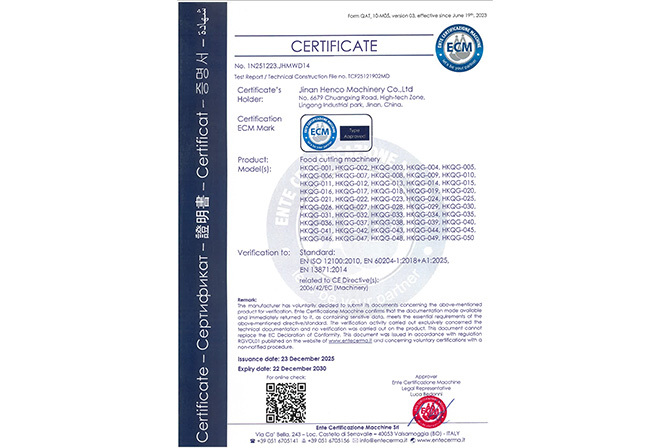
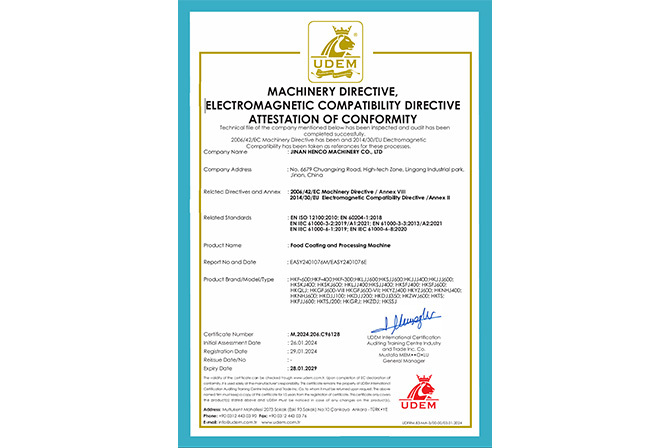
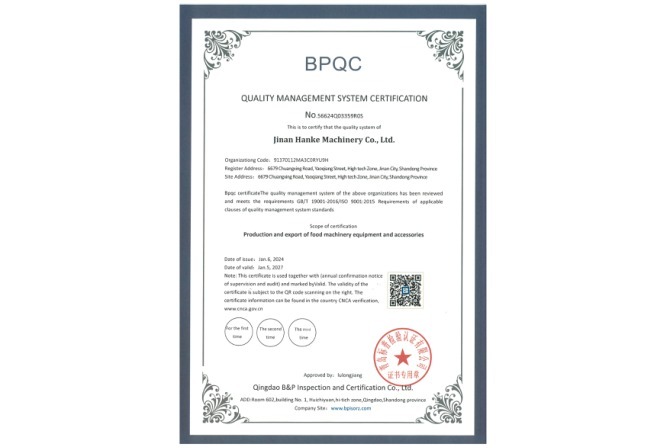
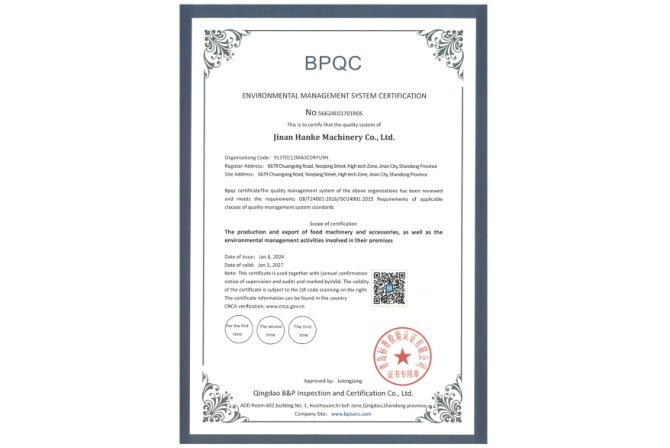
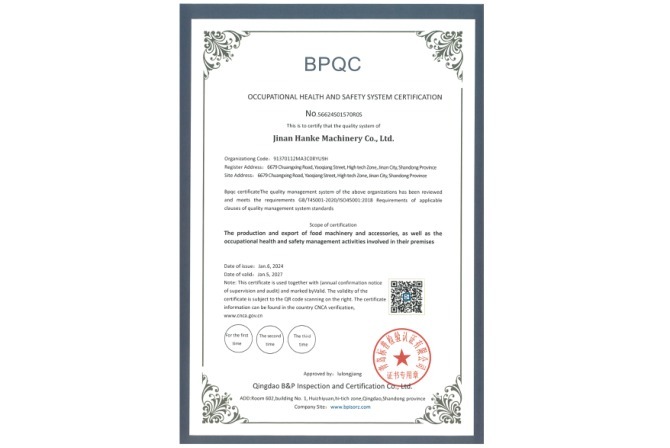
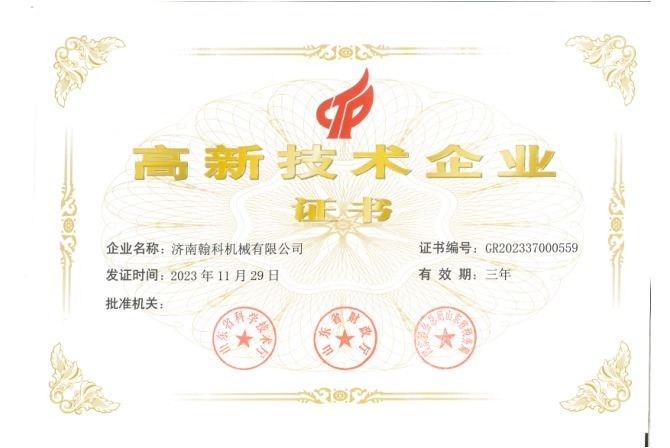
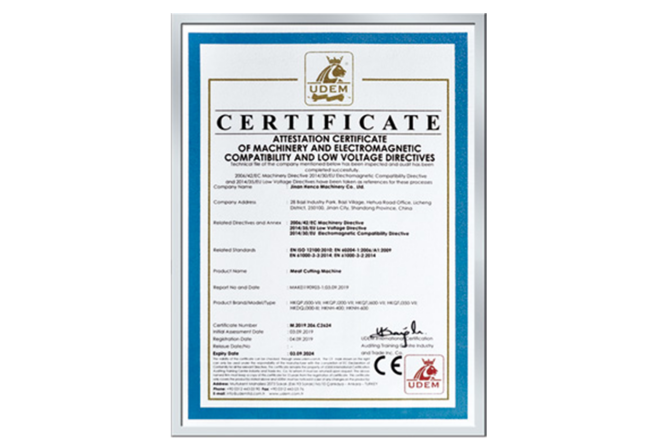
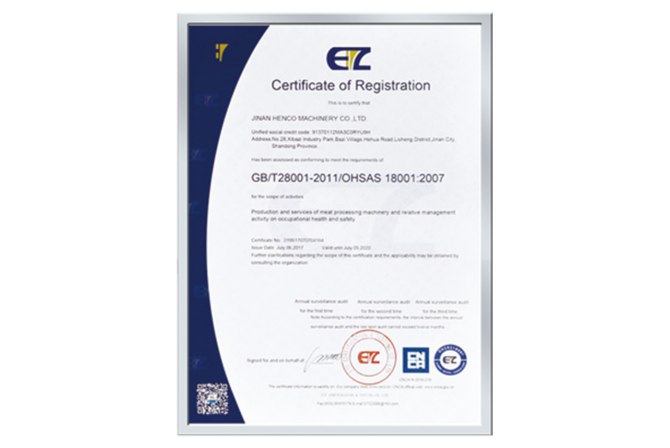
Our machines are CE certified and our management system certifications were obtained in 2022. We work to an ISO 9001 quality management framework across design, production and after-sales service, and the supporting documents travel with the shipment so that a customer's own compliance file is complete on arrival.
Export Experience and Markets
We have exported since our early years and now ship to customers across Southeast Asia, the Middle East, North America, Australia and South America. Named markets include Malaysia, the Philippines, Thailand, the UAE, Qatar, Canada, the United States, Australia, Brazil and Chile.
Exporting food machinery is as much a documentation and logistics exercise as a manufacturing one. Under the SOLAS convention, 100% of loaded containers require a verified gross mass declaration before they can be loaded, and we issue that figure only after the container is packed and weighed. Wooden packing is heat treated to the international standard for wood packaging, which you can read about on the IPPC ISPM 15 page, so that shipments are not held at the port for treatment.
Because our customers are spread across very different markets, we build machines for different power supplies, voltages and safety expectations. Confirming those details at the inquiry stage avoids the most common cause of delay, which is a machine that arrives ready to work except for its electrical supply.
How We Work With Customers
A typical order starts with a conversation about the product the customer processes, the output they need and the space they have available. From there our engineers propose a model or a line configuration with a quotation and a lead time. Where the requirement is unusual, we agree drawings before production begins.
Standard machines normally ship within 15 to 30 working days, and customized configurations take 30 to 60 working days because of design, mould or blade-set production. Customers are welcome to attend the factory acceptance test in person or to join by video call, and we can arrange a visit at short notice for customers already travelling in China.
After delivery, we support installation and commissioning, provide operator training material and supply spare parts from stock. Every machine carries a 12-month warranty, and technical questions are handled by the same engineering team that built the machine rather than by a separate call centre.
Our Development Since 2015
We began with a narrow range of cutting machines and a small workshop. Most of our early growth came from repeat orders and referrals, which is a slow way to grow but a good test of whether the equipment performs in the field.
The range expanded as customers asked us to solve the next problem in their process. Cutting machines led to forming machines, which led to coating equipment and then to complete lines, because a customer who had bought one machine wanted the rest of the process to match it. Our private-label business grew the same way, from customers who wanted our machines under their own brand.
Today the factory produces around 1,200 machines a year with a team of about 50 people and an R&D group of more than 30 engineers. The proportion of our output that is customized or private label continues to rise, which is the direction we expect the business to keep moving.
After-Sales Support and Spare Parts
A machine is only as good as the support behind it, and support is hardest to judge before you buy. We handle it with the same team that built the machine, because an engineer who knows the assembly can usually diagnose a fault from a photograph and a short description.
Installation and commissioning support is included with every order. For customers installing equipment for the first time, that means guidance on positioning, wiring, start-up and the settings the machine should run at for their product. Where a line has several stages, we help sequence the installation so that earlier stages can be tested before later ones are connected.
Operator training material travels with the machine, and we can walk a customer's engineers through changeover, cleaning and daily maintenance by video call. Most of the questions we receive after delivery are not faults at all but set-up questions, and answering them quickly is what keeps a machine productive in its first weeks.
Spare parts are held in stock for the models we sell most, including blades, blade guides, belts, mould plates and drive components. Blade life and belt life are the two items that determine running cost for most of our customers, so we keep both available and advise on the correct consumable for the product being processed. Every machine carries a 12-month warranty, and technical advice continues for the life of the equipment.
Working With International Buyers
Most of our customers are buying from outside China, often for the first time, and the concerns are predictable: will the machine match the specification, will the documents be correct, and who do I contact if something goes wrong.
On specification, we confirm details in writing before production and run a trial where the product allows it. On documentation, certificates, manuals and test records travel with the shipment rather than following later. On support, the customer deals with the engineering team directly, in English, rather than through a chain of intermediaries.
We also recognise that buyers compare suppliers on more than price. A lower quotation that arrives with incomplete documentation, a missing spare part or a machine that cannot be adjusted to the local product usually costs more than the difference in the initial price. Being clear about lead times, including the 15 to 30 working days for standard machines and 30 to 60 working days for customized configurations, is part of that honesty.
Where a customer wants to verify us before committing, we encourage a visit or a video factory tour, and we are comfortable being compared against other manufacturers on the same requirements.
What Our Customers Process
Our machines are used across the food industry, and the applications we see most often tell you more about our range than a specification list does.
Meat and poultry processing. Portion cutting, primal cutting, strip cutting for stir-fry and kebab production, dicing of frozen blocks for sausage and patty mixes, and tenderising of tougher cuts before grilling. This is the largest part of our business and the area where our cutting equipment has the deepest track record.
Seafood and fish. Portioning of fillets, coating of fish fingers and portions, and dicing for prepared seafood products. Fish products need gentler handling than red meat, so blade sharpness and feed control matter more than raw speed.
Vegetable and prepared foods. Slicing, shredding and dicing for ready meals, salads, frozen vegetable packs, soups and fillings, together with forming and coating of vegetable patties and croquettes. Vegetable products are the most varied in texture, which is why interchangeable blade plates matter so much.
Central kitchens and catering. Smaller operations that need consistent cut sizes at volume without investing in a full production line. These customers usually start with one or two machines and add capacity as their order book grows.
Across all four groups, the requirement is the same in principle: a repeatable output that the next stage of production can rely on. That is the standard we design and build to.
FAQ: About Jinan Henco Machinery
Where is Jinan Henco Machinery located?
Our factory is in Jinan, Shandong Province, China. Jinan is well connected by high-speed rail and by air, so customers visiting from overseas can usually reach us within a day of arriving in Beijing, Shanghai or Qingdao. We are happy to arrange a factory visit for customers who want to see machines running before they order.
What certifications do your machines carry?
Our machines are CE certified and our management system certifications were obtained in 2022. We operate to an ISO 9001 quality management framework, and we hold more than 20 national patents. Certification documents are supplied with the shipment so that your own compliance checks can be completed without waiting for paperwork from us.
Which markets do you export to?
We export across Southeast Asia, the Middle East, North America, Australia and South America, with named markets including Malaysia, the Philippines, Thailand, the UAE, Qatar, Canada, the United States, Australia, Brazil and Chile. Our annual export value is more than USD 3 million. Where a market has specific electrical or safety requirements, we confirm them before production.
Can we visit the factory before ordering?
Yes, and we encourage it. Customers and their engineers are welcome to see the workshop, watch machines running and discuss the configuration directly with our engineering team. If travelling to China is not practical, we can arrange a live video walkthrough of the factory and a test run of the machine you are considering.
If you would like to know more about how we can support your production, contact our team with a description of the products you process and the output you need. You can also learn more about our OEM and ODM service if you are considering selling machinery under your own brand, or explore our full machine range to see the equipment in more detail.
Factory Show
-
OEM and ODM service for food processing machinery: private label branding, custom machine configuration, branded manuals and export packaging.
-
Production process at our Jinan factory: cutting, welding and polishing of food-grade stainless steel, electrical assembly and safety testing.
-
Food processing machinery manufacturer since 2015: meat band saws, vegetable cutters, battering, breading and forming machines, built in Shandong.
-
Office and workshop environment at Jinan Henco Machinery: a 2,000 square metre production base with our own in-house R&D and quality control teams.
Certifications