



- Home
- >
- News
- >
- Nugget Production Line
- >
Nugget Production Line
2026-11-26 15:18Chicken Nugget Production Line: Five Stations and the Numbers That Have to Match
A nugget production line is usually bought as a list of machines and then assembled as a problem. Each unit is specified on its own, arrives on its own pallet, and meets the next one at a transfer point where the heights and the belt speeds do not agree.
This is the line written the other way round — station by station, with the numbers that have to match between them.
Station One: The Former
The former sets the product. A mould plate decides the shape, the cavity volume decides the portion, and the cycle rate decides the output: 25 to 35 cycles per minute on the standard DHCB240-Ⅲ, multiplied by the cavities the plate carries.
Three numbers from that machine matter downstream:
Outfeed height: 700–850 mm. This is the number that most often fails to match the next machine.
Belt speed: 3–15 m/min. The line runs at the former's speed, not at the fastest machine's.
Compressed air: 1.2 m³/min. Shared with the knock-out, and the first utility to be forgotten.
The 240 type forming machine carries the full table, and the forming guide explains what changes between patties, nuggets and meatballs on the same head.
Station Two: The Batter
Batter is where a nugget gets its adhesion layer — the part that holds the crumb on after freezing. The machine does one thing: it floods the product and blows off the excess, so that pickup is even across the belt.
What decides quality here is not the machine but the mix and the dwell: a batter that is too thick bridges the crumb and gives a smooth, pale nugget; too thin and the crumb falls off in the fryer. The machine's contribution is a belt speed that can be matched to the former — usually the same range, 3 to 18 m/min.
Station Three: The Breading
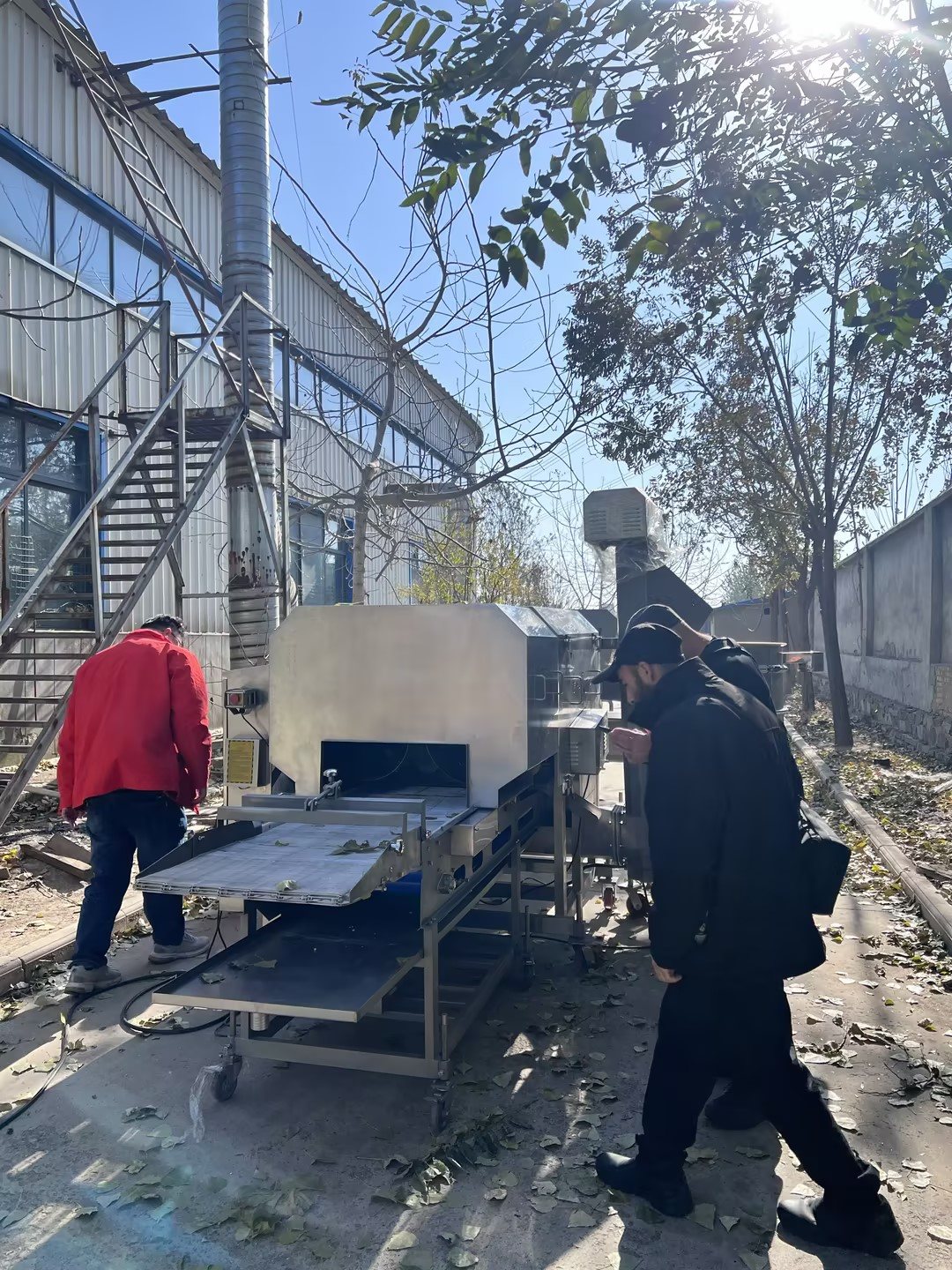
The breading machine applies crumb and recovers what falls through. The standard unit, HKSKJ600, gives a clear picture of how the station is specified:
| Parameter | Value |
|---|---|
| Belt width | 600 mm |
| Belt speed | 3–18 m/min |
| Input height | 870–970 mm |
| Output height | 1000 ± 50 mm |
| Power | 4.1 kW |
Two things stand out. The input height starts at 870 mm, while the former discharges at 700–850 mm — so the line needs a riser conveyor between them, and that conveyor is a line item nobody budgets at quotation stage. And the belt is 600 mm wide against the former's 240 mm, which is fine when product is spread across the belt and a problem when it is not: crumb coverage depends on spreading, not on belt width.
Station Four: Fry or Freeze
The order of these two decides what the crumb does.
Par-frying before freezing sets the crumb and gives the colour; freezing alone leaves a raw crumb that has to be finished by the customer. Neither is wrong, but the line is specified differently: a par-fry line needs the fryer, an oil system and a longer footprint, and it is usually a separate supply from the forming and coating machines.
What the forming line has to guarantee is that product arrives at the fryer or freezer at a consistent rate. A former that cycles at 35 per minute feeding a freezer belt that takes 25 has a buffer problem, not a capacity problem.
Station Five: Stacking and Packing
At the end of the line the product is stacked or boxed. The patty stacker is the unit that takes formed product off the freezer belt and stacks it; on a nugget line the same job is often done by a packing table and two people.
The decision here is early, not late: whether packing runs at line speed or in batches. A line that produces faster than the packers can box will stop, and the stop will be blamed on the machines.
The Two Numbers That Break Lines
Transfer height. Former out at 700–850 mm, breading in at 870–970 mm. Every transfer point in a line needs the same check, because a 150 mm mismatch is a conveyor, a quotation change and a delay.
Belt speed. The slowest machine sets the line. If the former runs at 15 m/min and the breading at 18, the breading is not faster — it is idle. Lines are matched by setting every unit to the same speed and then checking whether the slowest one can reach the target output at all.
The Line at a Glance
| Station | Key numbers | What it decides |
|---|---|---|
| Former | 25–35 cycles/min, 240 mm belt, 3–15 m/min, 1.2 m³/min air | Shape, portion, line speed |
| Batter | 3–18 m/min | Adhesion, crumb pickup |
| Breading | 600 mm belt, 3–18 m/min, in 870–970 mm, out 1000 ± 50 mm | Crumb coverage, recovery |
| Fry / freeze | separate supply | Crumb set, colour, shelf life |
| Stack / pack | matches freezer belt | Whether the line actually runs |
What to Settle Before a Quotation
The product and its weight, with the plate that makes it.
The output per shift, including cleaning and changeover.
Which stations are in scope — former, batter and breading, or the fryer as well.
The transfer heights, machine by machine, not line by line.
The utilities — air, power, steam, drainage — checked against each unit's own figure.
The patty and nugget process line shows how the three coating stations are built as one frame set, and the plant guide covers where the line sits in a building.
A worked example of the whole sequence — a buyer walk-through, the three things flagged on the day, and what came next — is in the Israel forming line visit.