


- Home
- >
- Case
- >
- Forming Line for Israel
- >
Forming Line for Israel
Forming Line for a Frozen Food Producer in Israel: Factory Visit and Specification
A producer from Israel spent 25 November at our works to look at forming equipment for a coated product line. The visit was not a machine demonstration — it was a specification session with the machines in front of us, and it ended with a list of numbers rather than a quotation.
What They Came With
Three things, which is more than most first visits bring: the product they want to run, the weight per piece they sell at, and a shift target in kilos. That is enough to define a line, because everything else — plate, belt speed, crumb station, fry or freeze — follows from those three.
What they did not have was a decision on the last station. Par-fry before freezing, or freeze raw and let the customer finish it, changes the line's footprint and its cost more than any machine choice upstream.
What the Day Looked Like
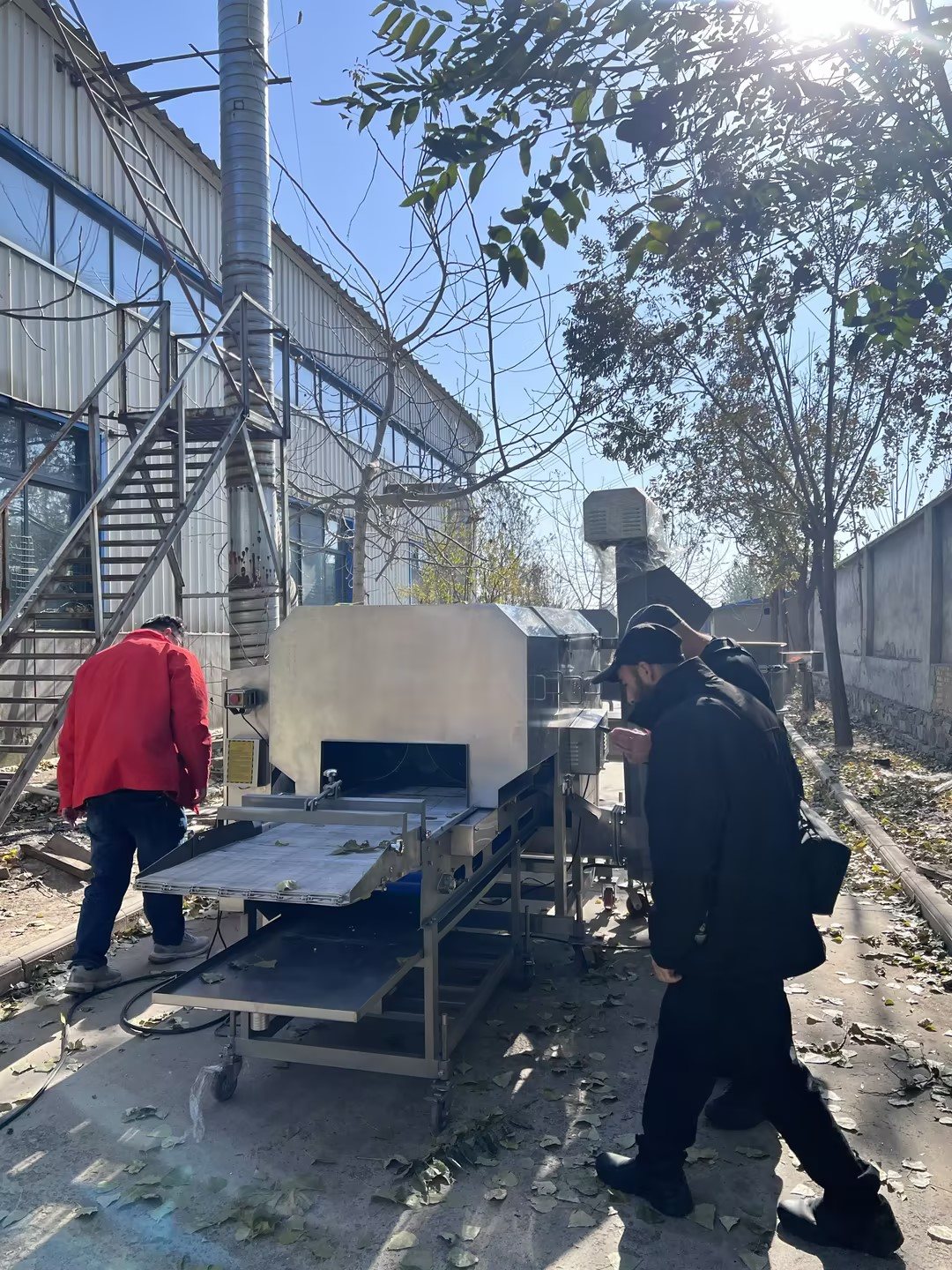
The units were set out on the apron outside the workshop rather than in a showroom, which is how a line is actually seen: at ground level, with the guards open and the belts running.
The buyer went down on one knee to look under a belt unit at the frame and the drive — the part a catalogue photograph never shows.
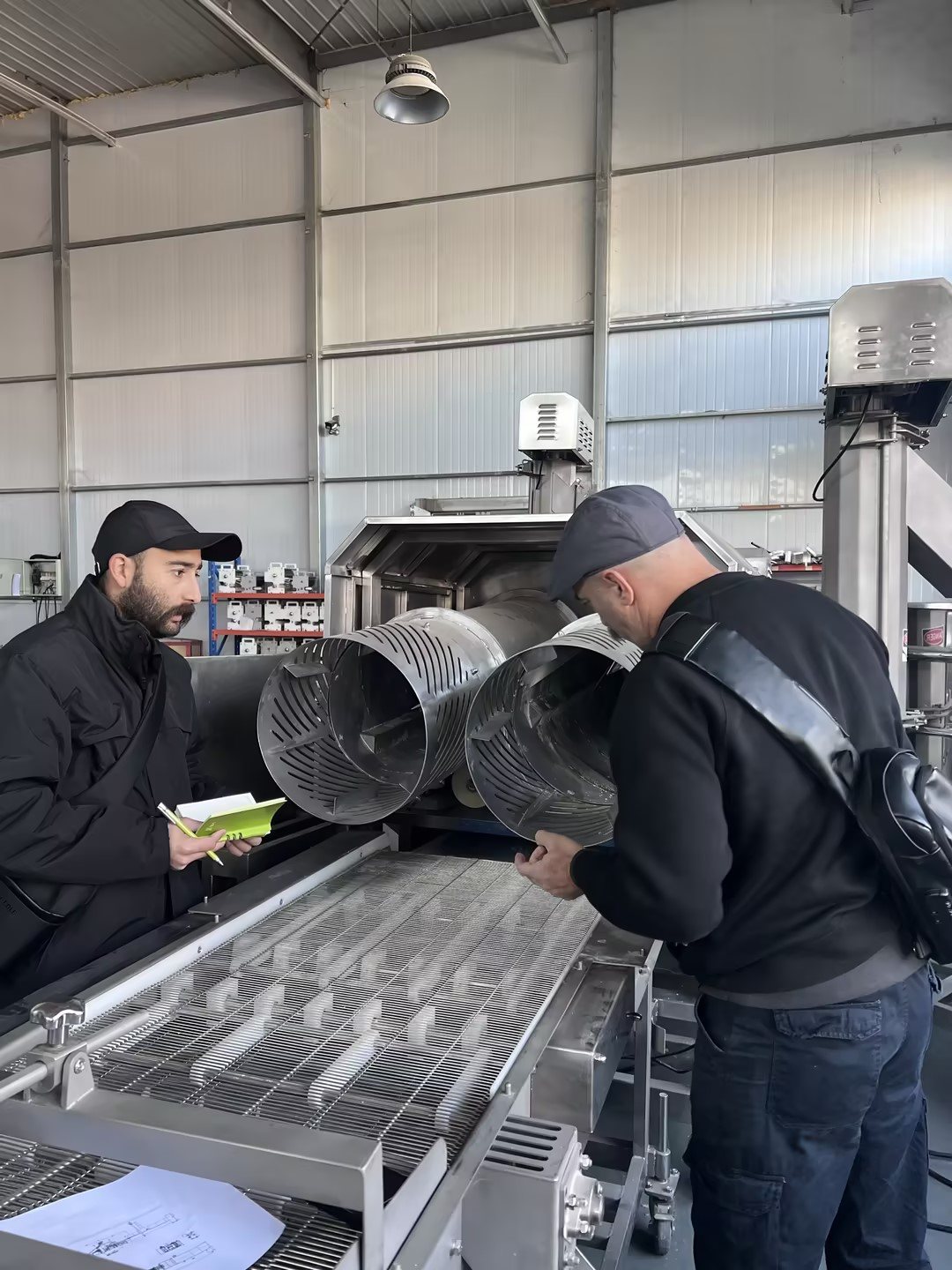
At the drum unit the conversation was about crumb, not steel: what size crumb the drum handles and how much of it comes back.
One of the party photographed the control panel and the plate carrier, which is the right thing to photograph.
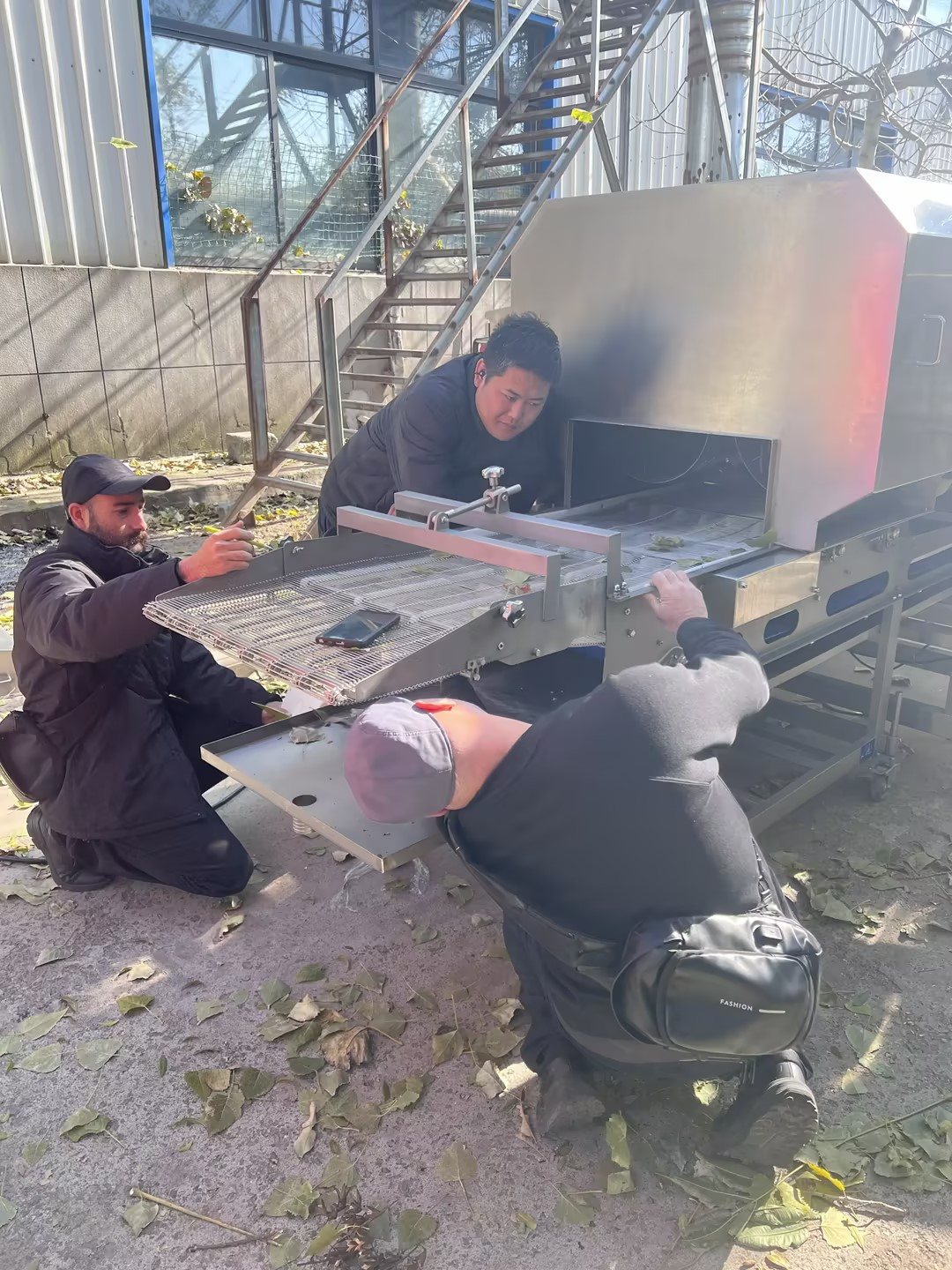
Seeing machines outdoors, side by side, also makes the transfer heights obvious. Indoors, each machine looks fine on its own pallet.
What the Line Was Defined Around
The former. A 240 mm belt machine cycling 25–35 times a minute, with the plate chosen for their piece weight. The plate, not the frame, is what decides the product range, so the discussion was about how many plates the line needs rather than which model.
The coating stations. Batter then crumb, on 600 mm belts running up to 18 m/min. The crumb station recovers what falls through, which matters at their volume because crumb loss is a running cost, not a one-off.
The utilities. Compressed air at 1.2 m³/min for the former alone, checked against what their plant can hold. This is the item that most often turns a signed order into a commissioning problem.
Three Things We Flagged on the Day
Transfer height. The former discharges at 700–850 mm; the breading machine takes product in at 870–970 mm. A riser conveyor is needed between them, and it belongs in the drawing rather than in a later change order.
Belt speed matching. The line runs at the slowest station's speed. A former set at 15 m/min feeding a breading belt at 18 does not run faster — it runs unevenly.
Packing rate. If packing runs in batches rather than at line speed, the effective output is the packing rate, and the line should be sized to it rather than to the former.
What Happens Next
The sequence from here is the standard one: a sample of their mix run on the chosen plate, a layout drawing with the transfer heights and the utility requirements, and a quotation against that drawing.
A quotation issued before the drawing exists is a price attached to an assumption — the most expensive document in a project, because it is the one everybody remembers.
Where This Sits
The technical detail behind the day is in the nugget production line guide, which sets out the five stations and the numbers that have to match between them. The forming machine guide covers the former itself, and the patty and nugget process line is the product page for the coating stations.
For plants still deciding where the line belongs, the room-by-room plant guide covers the layout side.