



- Home
- >
- News
- >
- Meatball Machine Guide
- >
Meatball Machine Guide
2026-11-25 13:41Meatball Machine: What a Gulf Buyer Checks Before Ordering
On 24 November a buyer from Bahrain spent a day at our works in Jinan to look at forming equipment. The meeting started in the reception room, moved into the workshop, and ended in front of a machine with the hopper open and the mould plate out on the table.
What he came to answer is not a catalogue question. A meatball machine is bought against a product — the kofta mix his plant runs, the size his customers buy, and whether the ball survives freezing. This is what a day like that actually settles.

What the Visit Covered
Three parts, in the order they usually happen.
The table. Product first: what goes into the mix, how cold it is when it reaches the former, and what weight the pack is sold at. Nothing about the machine is decided before this, because a ball formed from a warm, wet mix behaves nothing like one formed from a cold, stiff mix.
The workshop. A walk past the machines on the floor — forming units, conveyors, and the coating line downstream. Seeing the frame and the plate carrier in the metal answers questions a drawing cannot: how the plate comes out, how much clearance there is for a gloved hand, and where the air lines run.
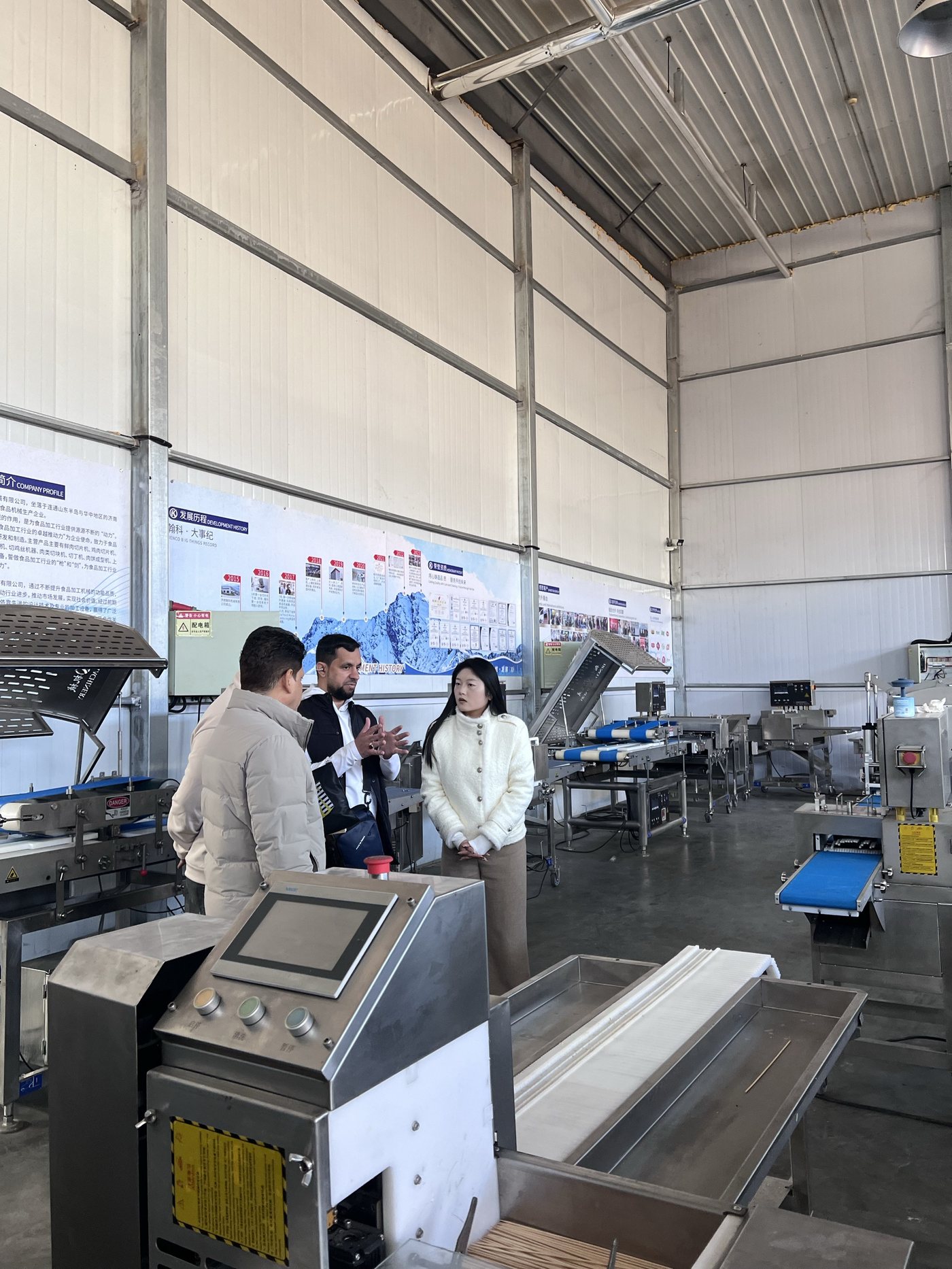
The machine itself. Hopper open, plate out, knock-out checked. This is where the specification stops being a table and becomes a machine — and where most buyers change their mind about size.
Why a Ball Is Harder Than a Patty
A patty is a disc: the plate is shallow, the knock-out is flat, and if the edge is slightly wrong nobody notices.
A ball is different in three ways:
The cavity is deep. Filling a deep cavity evenly needs more consistent pressure than filling a shallow one, or one side of the ball is dense and the other is hollow.
The knock-out can flatten it. The ball has to leave the plate without a flat side, which is why the knock-out shape and the belt speed have to be matched to the cavity depth rather than to the frame.
Weight drifts with wear. A deep cavity erodes faster at the shoulder than a shallow one, and the drift shows up as heavier balls, not as a visible defect.
None of that appears in a spec sheet, which is why the plate — not the machine — is the part to negotiate.
The Numbers That Do Appear on the Sheet
The standard former in our range, the DHCB240-Ⅲ, gives a fair picture of what a forming machine is specified by:
| Parameter | Value | Why it matters for balls |
|---|---|---|
| Working frequency | 25–35 cycles/min | Sets output; a four-cavity plate gives four balls per cycle |
| Compressed air | 1.2 m³/min | Fill and knock-out are air-assisted — the figure most plants fail to check |
| Filling area | 200 × 140 mm | Limits how many cavities fit, and therefore the ball diameter |
| Conveyor belt width | 240 mm | Must carry the row without the balls touching |
| Belt speed | 3–15 m/min | Too fast and the ball rolls; too slow and the next row collides |
| Installed capacity | 0.2 kW | Small, because the work is done by air and mechanics |
| Outfeed height | 700–850 mm | Has to match the freezer belt or the trays |
Two of these decide whether a meatball line works: the air supply and the belt speed. A plant that cannot hold 1.2 m³/min gets under-filled balls that look like a plate problem, and a belt that runs too fast turns a sphere into a teardrop.
The Gulf Product Mix
A buyer in Bahrain is usually forming two things on the same machine: a spiced kofta-type mince, and a plain meatball for retail packs. Both run on the same frame; what changes is the plate, the mix and the target weight.
That has one practical consequence for specification: the machine should be quoted with more than one plate. A single-plate quotation looks cheaper and then costs a second order plus freight when the product range widens, which in this category it almost always does.
Testing Before Shipping
A factory visit answers the machine question; a sample test answers the product question. The two are not the same, and the second one is the cheaper place to find a problem.
What the test needs from the buyer is four things: the mix recipe, the temperature the mix will be at the hopper, the target weight, and the target diameter. With those, the plate is chosen and a batch is run before the machine is packed.
What the test proves is that the ball forms, releases and holds its shape at the specified weight. What it does not prove is how the product behaves after freezing, or how it packs — those are plant questions, and they are answered by freezing the sample at the customer's own conditions rather than by anything the machine can show.
Where the Machine Sits
A former is rarely the only machine in the decision. Downstream there is a freezer belt, a tray or a packing table, and often a coating line if the product is breaded. Upstream there is a mixer and a chiller, and the temperature of the mix at the hopper is decided there rather than at the former.
The food forming machine guide is the index for this product family — it covers patties, nuggets and cutlets on the same head. The 240 type forming machine carries the full specification, and the patty and nugget process line shows what the downstream looks like when the product is coated.
If the plant is still being laid out, the room-by-room plant guide covers where a former belongs and what it needs around it.