



- Home
- >
- News
- >
- Day Two at Gulfood 2026
- >
Day Two at Gulfood 2026
2026-11-04 16:15Gulfood Manufacturing 2026, Day Two: What the Gulf Asks a Line to Do
Day one at stand S-404 was people walking the wall of four posters, reading the line names, and asking what each one does. Day two is a different room: buyers arrive with appointments, folders and photographs of their own plant, and the question stops being *what does it do* and becomes *will it do it here*.
That is not a small difference. In this region, "here" changes the specification.
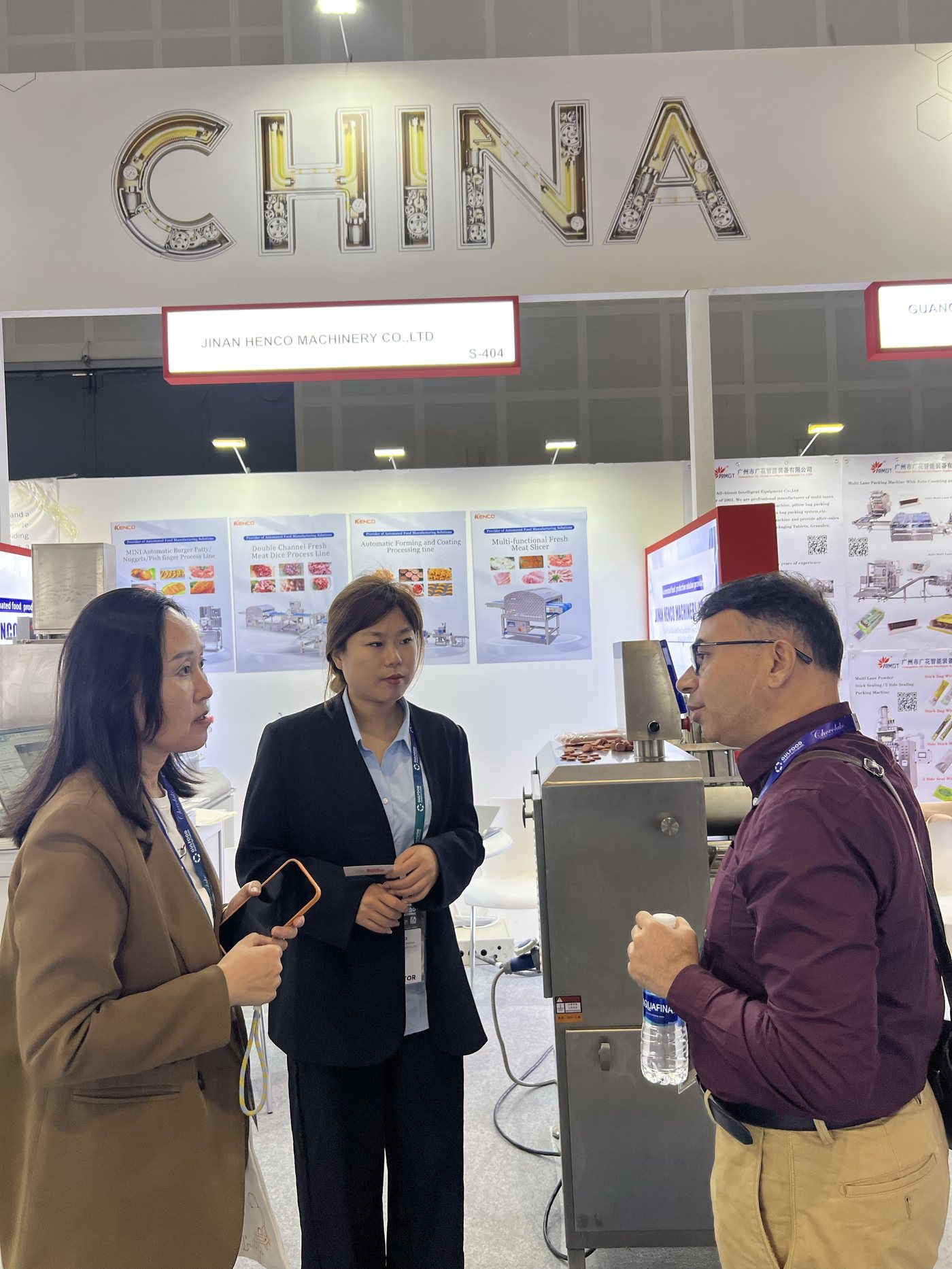
Day two, at the counter: appointments replace passing traffic.
The Second Day Has a Different Queue
Day one is a scanning day. Traffic is high, conversations are short, and most of what happens is a visitor working out whether the stand is relevant.
The second day is when the diary takes over. The people who come back are the ones who already know the machine type they need; what they are testing is whether the supplier understands their plant. On our stand that showed up as folders on the counter, phones held out with photographs of an existing line, and — as the day went on — groups gathering at the front for a photograph before leaving.
The conversations that ran longest were not about throughput. They were about configuration.
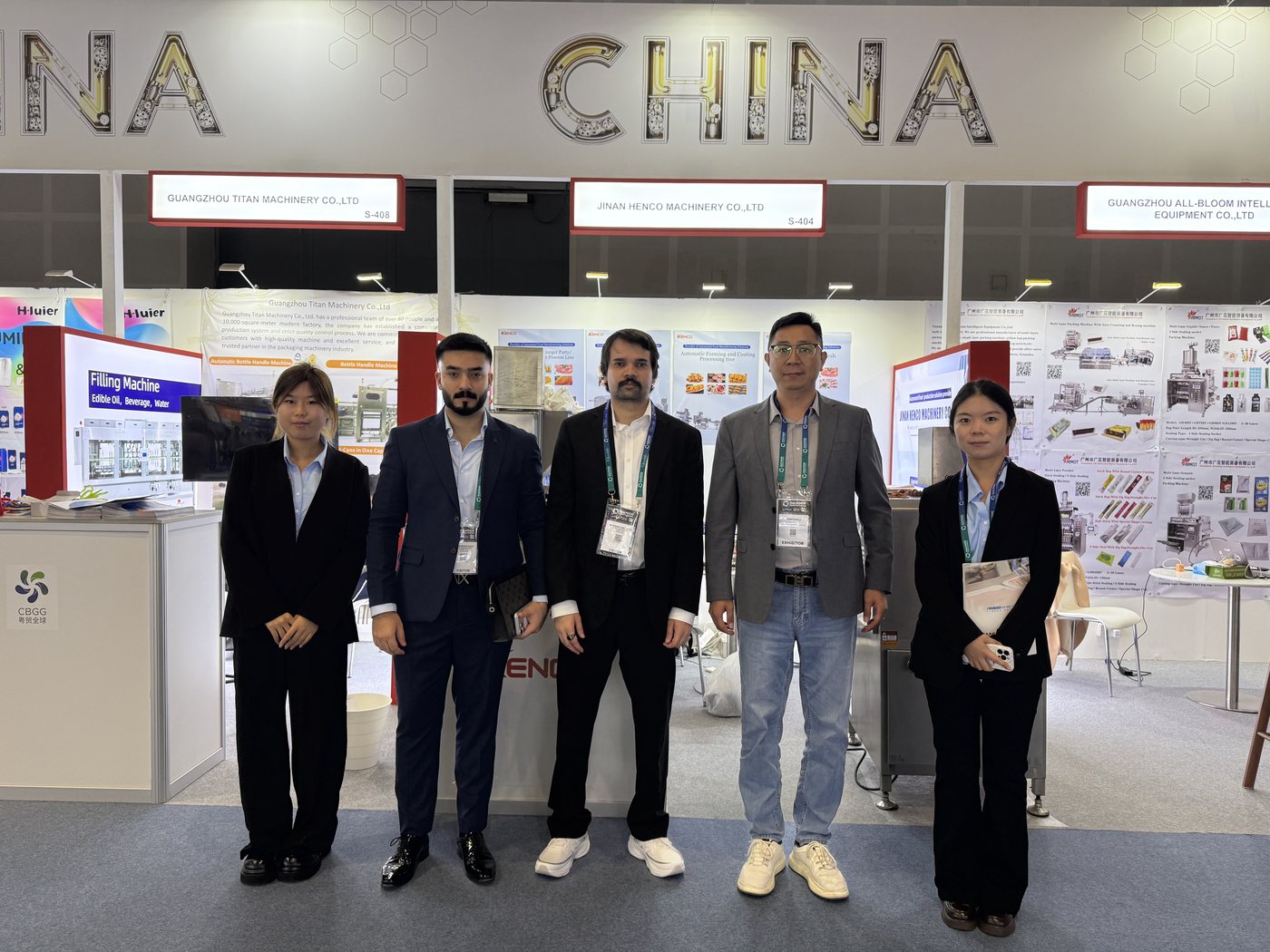
Groups gathered at the front of the stand as the day went on.
Four Things the Gulf Changes
1. Power and frequency
The Gulf runs at 50 Hz, with three-phase supply at roughly 380 to 400 volts in most plants and 220 to 240 volts single phase for smaller units. That is compatible with machines built for most export markets, but it is not automatic. A machine specified for a 60 Hz market has different motor speeds, different pump curves and different heater loads once it arrives.
What has to be confirmed before a quote: the voltage and phase actually available at the wall, whether the plant has a step-down transformer, and whether the control circuit is fed from a separate 24 V supply. Getting this wrong is not a commissioning problem; it is a rebuild.
2. Heat, humidity and salt air
Summer ambient in the Gulf passes 45 °C, and coastal plants run at high humidity for months. Three parts of a processing line feel it first: the control cabinet, anything that is not stainless, and the refrigeration side.
In practice that means a cabinet with its own cooling or air conditioning rather than a sealed box relying on passive ventilation; fasteners, frames and guards specified in stainless rather than painted carbon steel; and motors with enough thermal margin that they are not running at their limit on the hottest week of the year. It also means accepting that a machine which performs perfectly in a temperate plant can fail here for reasons that have nothing to do with its design.
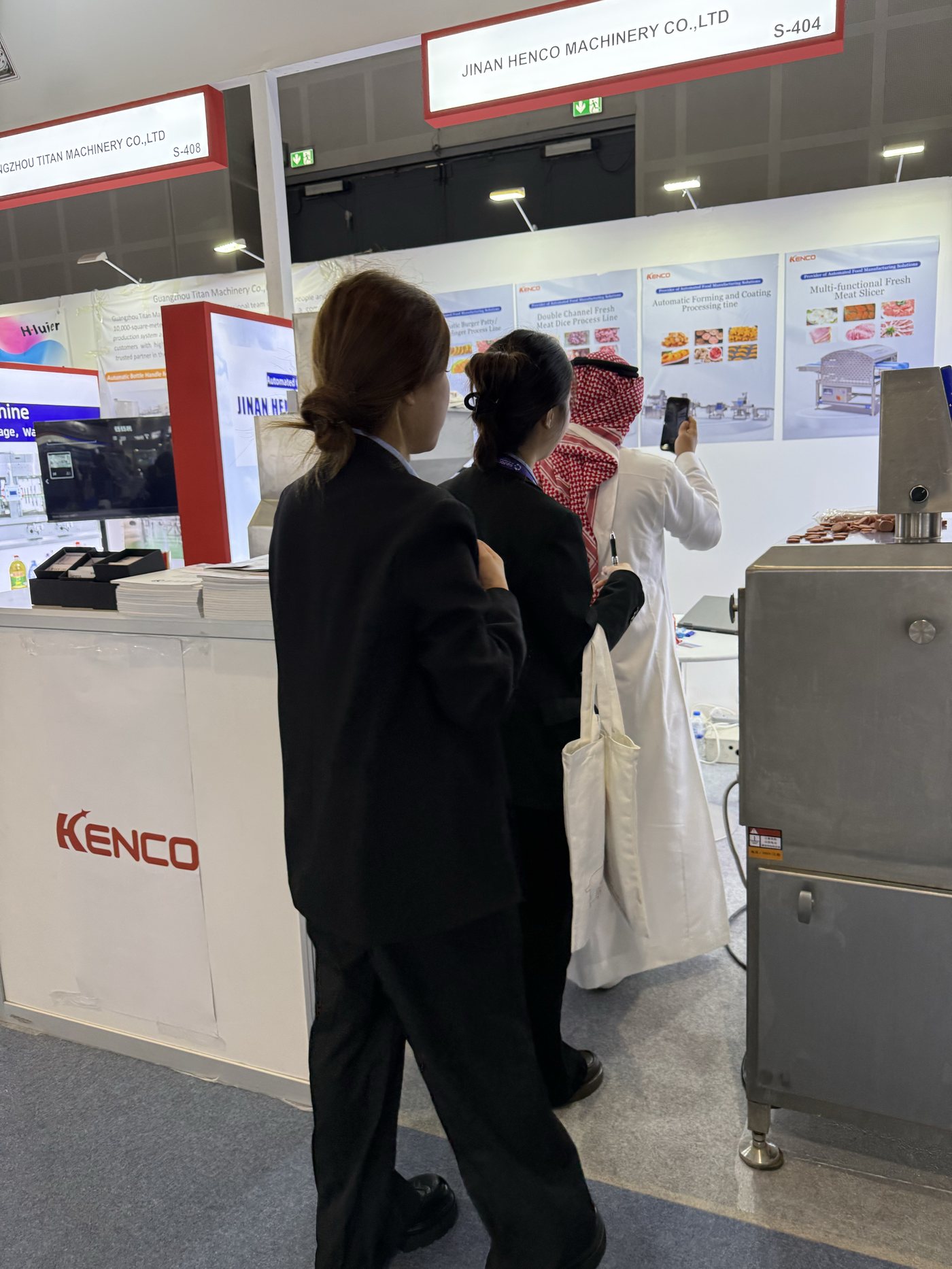
A buyer walking the machine with our team on day two.
3. Water and washdown
Meat plants in the region wash down with hoses, and the water is often hard. Two consequences follow: the machine has to be built to be hosed rather than wiped, and any part of the line that uses water — humidification, steam, cleaning circuits — has to survive scale.
A washdown plant rewards an open frame that drains and a cabinet that is rated for wet cleaning. It punishes box sections that hold water and electronics mounted at floor level.
4. Distance
The Gulf is roughly four weeks of sea freight from China, and spare parts follow the same route. Buyers here ask about it directly, and the honest answer is that a spare parts kit shipped with the machine is cheaper than an air freight shipment six months later.
Commissioning works the same way: either a technician travels, or the plant is walked through remotely with someone holding a phone at the machine. The four-hour time difference between China and Gulf Standard Time makes the second option practical, which is not true of every export market.
What That Changes on the Quote
| Row on the spec sheet | Temperate default | Gulf specification |
|---|---|---|
| Voltage / frequency | 380 V, 50 Hz or 60 Hz variant | 380–400 V, 50 Hz confirmed at the wall |
| Control cabinet | Sealed, passive ventilation | Cabinet cooling or AC, higher IP rating |
| Frame and guards | Painted carbon steel | Stainless, open frame that drains |
| Spare parts | On request | Consumables kit shipped with the line |
| Commissioning | On-site visit | On-site visit or remote walkthrough |
None of these rows changes what the machine makes. All of them change whether it keeps making it in August.
If You Are Coming on the Last Day
The show opens on 3 November and closes on the 5th; the last day ends at 17:00 rather than 18:00. We are on stand S-404, inside the Chinese pavilion.
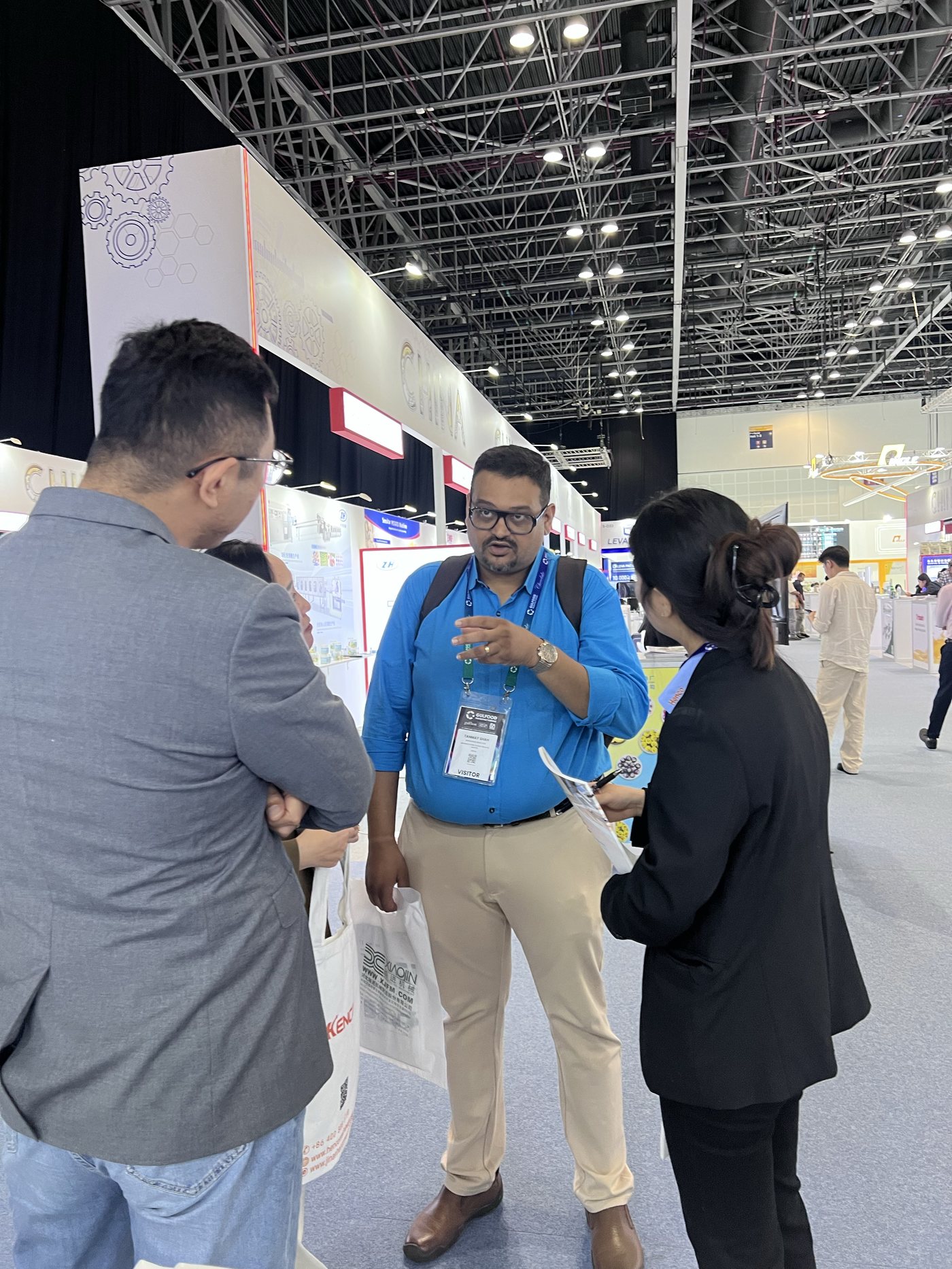
The aisle outside S-404 on the last morning.
If you are coming specifically to specify a line, bring four things: a photograph of the product you want to end up with, the output you need across a shift, the footprint and ceiling height you have, and the voltage at your wall. With those four, a conversation on a stand can turn into a real specification rather than a catalogue exchange.
The four lines on the stand are described in the day-one report; the dates and the visitor route are on the Gulfood Manufacturing 2026 page; every stand we have held at this show is listed on the Dubai exhibitions page; and the equipment range itself is grouped under food processing lines.
Frequently Asked Questions
It opens on 3 November 2026 and closes on the 5th, at the Dubai World Trade Centre. The first two days run 10:00 to 18:00, the last day ends at 17:00.
Inside the Chinese pavilion, on Sheikh Zayed Road at the Dubai World Trade Centre.
A photograph or sample of the finished product, the output required per shift, the floor space and ceiling height available, and the voltage and phase at your wall.
Yes, and it should be specified at the quotation stage rather than corrected on site. Voltage, cabinet cooling, stainless specification and the spare parts kit are the four rows to settle first.