



- Home
- >
- News
- >
- Meat Cutting Machine
- >
Meat Cutting Machine
2026-10-29 16:50Meat Cutting Machine: How a Saudi Buyer Sized a Fresh Meat Strip Line
On 29 October 2026 a meat processor from Saudi Arabia spent the afternoon in our Jinan workshop in front of a fresh meat strip cutter. He had not come to choose between two brands. He had come to settle two things a catalogue cannot answer: which capacity class fits the line he already runs, and what he should check before he signs anything.
Both questions are about the same machine. This is what we went through, and what any buyer sizing a meat cutting machine for a fresh meat line should put on the table before the quotation stage.
What the visit was actually about
A strip cutter is not a complicated purchase on paper. It has one job: push boneless fresh meat through a set of blades and deliver strips of a fixed width. What makes the decision slow is that the same machine is built in two very different sizes, and the difference is not a feature list — it is throughput. It is one of several machines in our food cutting machine range, and the one that sits closest to a fresh meat slicer in the line.
On the floor that day were the two models we build for this work. They look like the same design because they are: same blade principle, same chain plate belt, same control philosophy. What separates them is how much meat passes through in an hour, which is the only real distinction between one meat cutting machine and the next in this range.
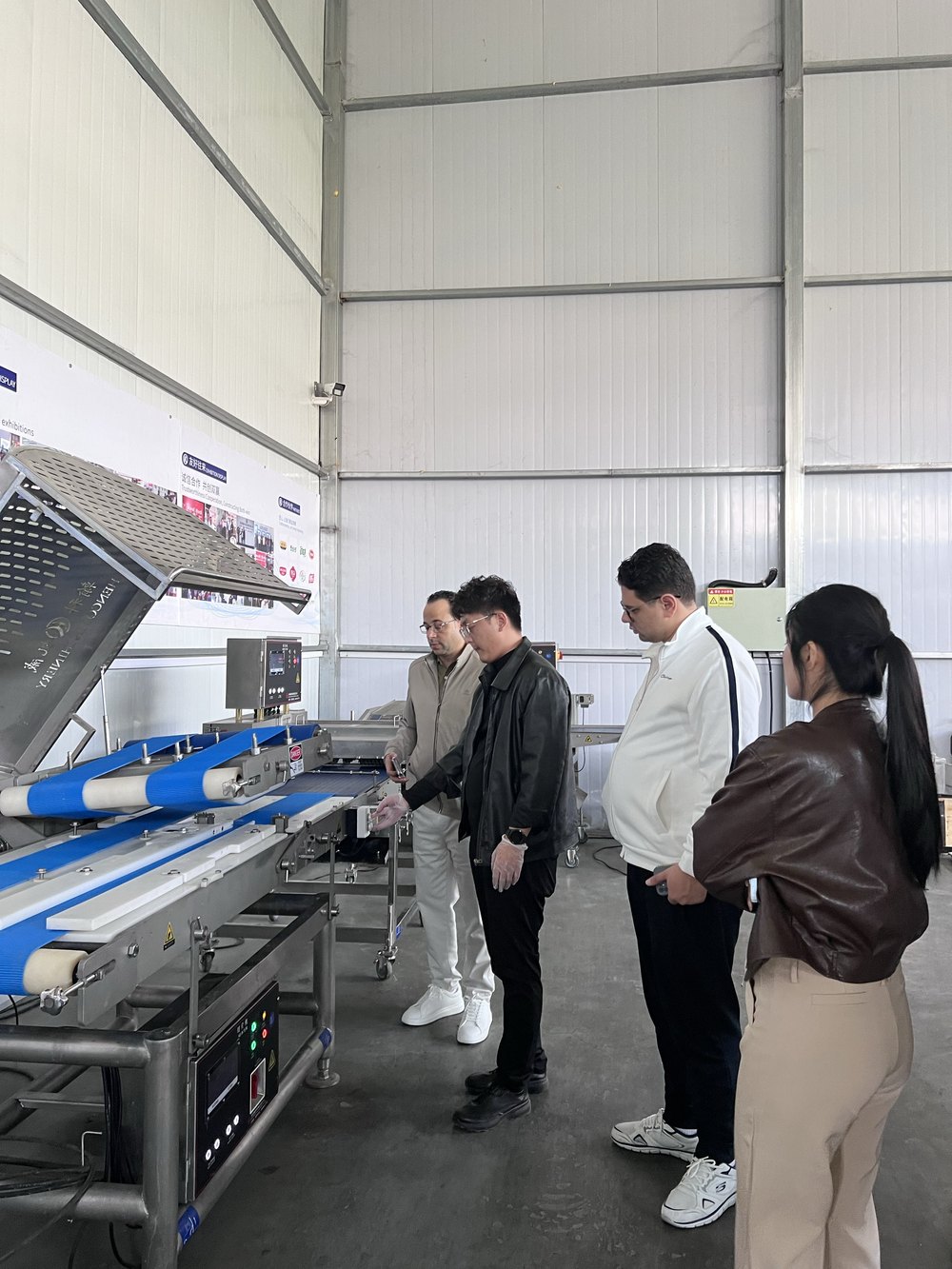
One blade set, two capacity classes
| Model | Belt width | Cutting width | Cutting thickness | Power | Capacity |
|---|---|---|---|---|---|
| HKQTJ300-VII | 300 mm | 200 mm | 5–35 mm | 1.5 kW | 300–500 kg/h |
| HKQTJ600-VII | 600 mm | 500 mm | 5–70 mm | 1.85 kW | 600–1000 kg/h |
The number that surprises buyers is the cutting width. On the smaller machine it is 200 mm; on the larger one, 500 mm. If you are cutting chicken breast fillets laid flat, a wider cutting width means more strips per pass and fewer passes per kilo. If your product is already portioned into narrow pieces, that extra width buys you nothing and costs you floor space.
The number that decides the model
Capacity is where most specifications get written backwards. A buyer looks at the cutter first, then asks whether the rest of the line can keep up. The useful order is the opposite: start with what happens after the cut. Sizing a meat cutting machine from the downstream stage is the difference between buying capacity you use and capacity you store.
If a dicer, a marinator or a packing table downstream can only absorb 400 kg an hour, a 1,000 kg/h cutter does not make the plant faster. It builds a buffer that has to sit somewhere, and fresh meat in a buffer is meat warming up. If instead the downstream stage runs two shifts and the cutter is the constraint, the larger model removes a bottleneck that would otherwise appear the week after installation.
The practical question is not "how fast is the machine" but "which stage stops first". On a single shift with a modest downstream, the 300–500 kg/h class is usually the honest answer. Where the cutter feeds a line that already runs continuously, the 600–1000 kg/h class stops being a luxury.
What ran on the belt that afternoon
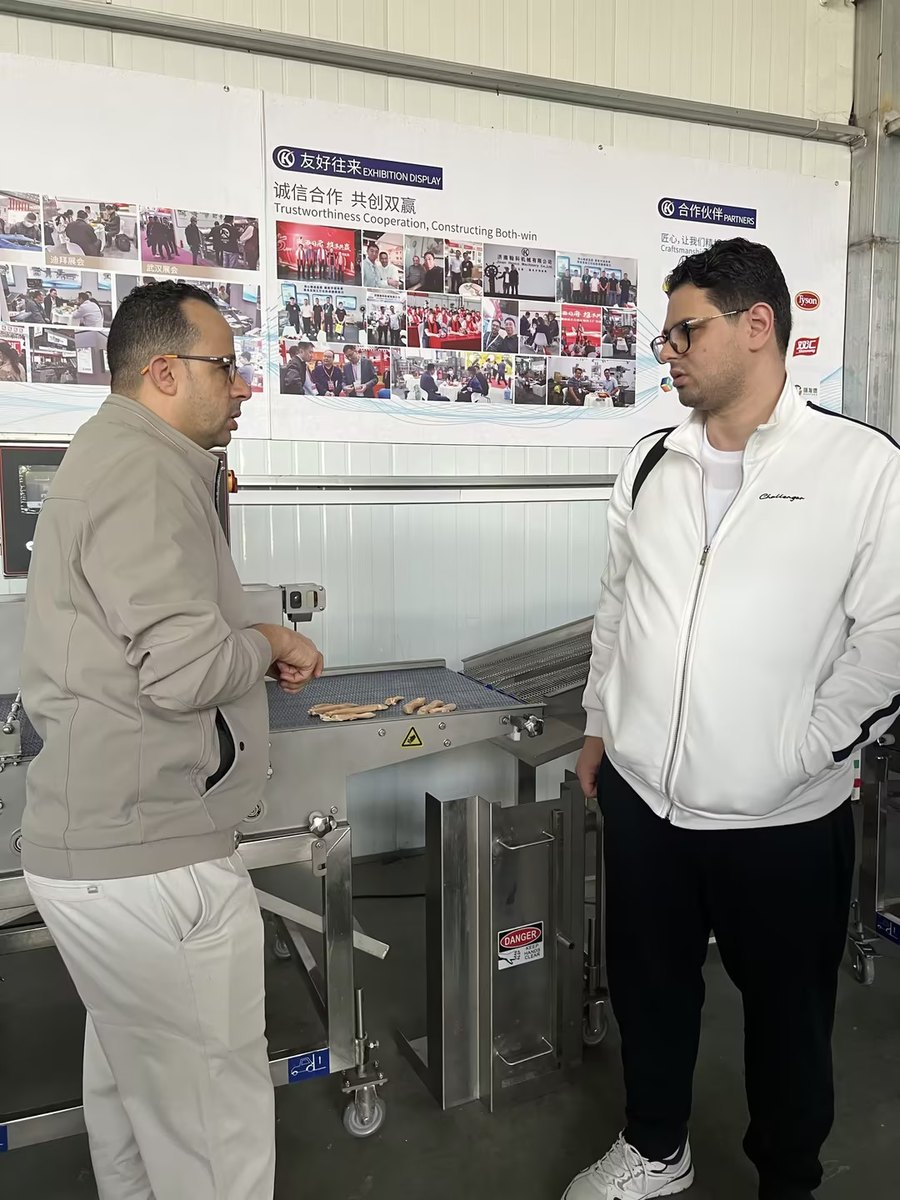
We ran fresh chicken breast and fresh beef through the smaller fresh meat cutting machine, with the blade set fitted for strips rather than for dicing. Fresh meat is soft, and soft meat deforms instead of cutting cleanly — which is why the machine holds the product with a knife press claw as the blade set passes through, instead of relying on the belt alone to keep it square.
The blade is 191 mm in diameter, 1 mm thick, in SUS420J2 stainless steel. Strip width comes from the spacing of the blade set, not from a dial: change the set and you change the width. Cutting length is set by the feed stroke. That is worth knowing before the quotation stage, because the blade set is the part of the order that is specific to your product.
Output on the day tracked the specification range rather than the top of it. Capacity figures assume well-chilled product; warm meat has to be run slower to avoid tearing, and no amount of blade sharpness changes that.
Four checks before sign-off
These are the things worth watching with your own product on the belt, in this order.
1. Width consistency across the full cutting width
Measure strips from the left edge, the middle and the right edge of the belt, not just one sample from the centre. A machine can hold width in the middle and drift at the edges.
2. Square edge, not a smear
A clean cut leaves a flat face. A smear means the blade is pushing rather than cutting — usually temperature, blade condition, or product being fed faster than the set speed allows.
3. Belt tracking under load
The chain plate belt is food grade POM. Watch it with product on it, not empty: that is when tracking problems appear.
4. Cleaning access between blades
Ask to have the blade set lifted out in front of you. If residue can sit between blades, it will — and that is a hygiene problem that shows up in an audit, not on the first day.
What changes for a plant in Saudi Arabia
Three things are worth settling at order stage rather than on arrival.
Grid frequency. Saudi Arabia runs a 60 Hz supply, so the motor and drive specification has to be confirmed against the plant's actual supply rather than assumed from a 50 Hz quotation. Buyers from the region who want to see the machine before ordering will find us at Gulfood Manufacturing 2026 in Dubai from 3 to 5 November.
Ambient temperature. Chilled meat warms quickly on an open belt in a hot room. Shorter runs between chilling, and keeping the product covered up to the infeed, matter more here than in a temperate plant.
Wash-down and salt. The standard build is 304 stainless steel, which suits most meat plants. Where the product is heavily salted or the machine is washed with aggressive chemicals, grade 316 is the specification to discuss — it costs more at order and considerably more to revisit later.
What the afternoon did not settle
A visit answers the questions that need a machine in front of you. It does not answer the ones that need your product.
The final blade set depends on the exact strip width and length you sell, which is why we quote blade sets against a finished piece size rather than against a model number. Marinade uptake, if the strips go into a tumbler next, is a downstream question. Packing format decides whether strips leave the line on a tray or loose. None of that is guesswork we should do on your behalf.
The honest next step is a sample run: send the product and the target strip dimensions, and the confirmation comes back as a blade set specification and a capacity figure for that product — not for a generic one.
After sign-off
Standard machines ship within 15 to 30 working days, and customised blade sets within 30 to 60. Machines carry a 12-month warranty with spare blade sets held in stock, and operators are trained on blade change and cleaning, since those two routines decide both hygiene and blade life.
If the strips are going on to a second cutting stage, the strip cutter can be run as a line with a dicing machine rather than as a standalone unit — see how that arrangement works in a fresh meat dicing line. That decision is easier to make with the finished piece size in hand, and it is worth making before the order rather than after.
Frequently asked questions
Which model suits an output of about 500 kg per shift?
A single shift of 500 kg sits inside the 300–500 kg/h class of the HKQTJ300-VII, with the exact figure depending on product temperature and how many width changes the shift needs. Send the shift length and the piece size and the number can be worked out properly.
Can one blade set produce more than one strip width?
No. Strip width is set by the spacing of the blade set, so a different width needs a different set. Many plants order two sets at the start rather than adding one later, because a second set is cheap at order stage and slow to arrive mid-season.
Why do strips tear at the ends?
Usually three causes: product too warm, blade set past its edge, or product fed faster than the machine is set for. The ends are where a dull blade first loses its cut, which is why they show the problem before the middle of the strip does.
What power supply should a Saudi plant specify?
The machine is 1.5 kW on the smaller model and 1.85 kW on the larger one, but the supply specification has to match the plant: Saudi Arabia runs at 60 Hz, so voltage and frequency should be confirmed from the site supply rather than copied from a 50 Hz quotation.
How long is delivery, and what comes with the machine?
Standard machines ship within 15 to 30 working days; customised blade sets take 30 to 60. The machine carries a 12-month warranty, spare blade sets are held in stock, and operator training on blade change and cleaning is included.
Can the strip cutter feed a dicer directly?
Yes, it can run as a line with a dicing machine so strips are cross-cut into cubes in a second stage. Whether that is better than a single machine depends on your target cube size and output — tell us the finished piece and we will say which arrangement fits.
If you are sizing a fresh meat line and want the strip width, capacity and blade set of a meat cutting machine confirmed against your own product, send us the finished piece size. The two strip cutting models are listed on the fresh meat strip cutting machine and automatic fresh meat strip cutting machine pages, and our exhibition schedule is on the exhibition activities page for buyers who prefer to compare machines in person.