



- Home
- >
- News
- >
- Bone Saw Machine Guide
- >
Bone Saw Machine Guide
2026-11-13 17:02Bone Saw Machine: A Buyer's Guide to the Four Types
A bone saw machine is the one piece of equipment in a meat plant that is bought almost entirely on price — and then blamed for years afterwards. The reason is that the specification sheet looks simple: a table, a blade and a motor. What it does not show is which of those three decides whether the cut is clean, whether the operator keeps their fingers, and whether the blade lasts a month or a week.
This guide sets out the four types we build, the numbers that actually differ between them, and the questions worth asking before an order.
What the Machine Actually Has to Do
Bone is not meat. It is hard, it is irregular, and it does not forgive a blade that is running at the wrong speed or a table that flexes under load. Three things follow from that:
The cut has to be clean. A blade that skates or chatters leaves bone dust and splinters in the product, and no downstream process removes them.
The pass height has to fit the product. A 160 mm maximum cutting height cannot take a whole frozen block, whatever the motor says.
The machine has to be cleanable. A saw that cannot be opened and hosed is a hygiene problem waiting for an audit.
Everything else — colour, brand, country of origin — matters far less than these three.
The Four Types, and Who Each One Suits
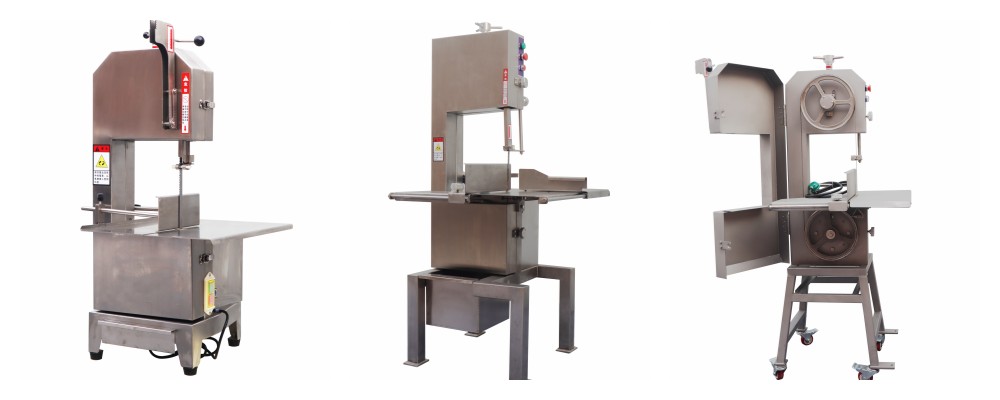
1. The counter-top saw
The smallest machines in the range are table-top units on castors: 220 V, 650 W and 1100 W in the two sizes, cutting thickness up to 155 mm and 180 mm respectively, with a maximum cutting height of 180 mm and 260 mm.
This is the butcher-shop machine. It suits a counter that cuts a few hundred kilos a day, where the operator stands at the saw rather than feeding it, and where the machine has to be moved for cleaning. It is not a production machine, and it should not be sold as one.
2. The single-column saw
The next step up is a floor-standing single-column saw: a 360 mm pass height, a 282 mm pass width, a 16 × 2495 mm blade on a 300 mm pulley, driven by a 2.2 kW motor at 1440 rpm, with a blade linear speed of 23 m/s and an emergency stop that brakes in 0.5 s. The whole machine weighs 142 kg.
This is the workhorse for a shop that cuts bone-in product all day. The 0.5 s braking figure is worth more attention than it usually gets: it is the difference between a saw that stops when the guard is lifted and one that coasts.
3. The five-section saw
The five-section machine exists for one job: turning a primal into fixed segments. Its maximum cutting height is 160 mm, its dimensional accuracy is 1.5 mm, and the segment width is set between 30 and 60 mm, with customisation available. Two 1985 mm and two 3355 mm blades run at 20 m/s from a 3.5 kW motor on 380 V; the machine weighs 370 kg.
If the product is sold by portion, this is the machine that decides whether the portions match. If the product is sold by weight, it is over-specified.
4. The CNC belt-fed saw
At the top of the range sits a belt-fed machine: a 300 mm conveyor belt, a 350 mm pass height, 3.95 kW of motor and 500 kg of machine, in a frame of 1620 × 1550 × 1720 mm.
This is the only one of the four that belongs in a line rather than at a table. It takes product from a conveyor, cuts to a program, and hands it on — which is why it is specified together with the machines on either side, not on its own.
The Four Side by Side
| Type | Max working height | Blade speed | Power | Weight | Suits |
|---|---|---|---|---|---|
| Counter-top (J210 / J310) | 180 mm / 260 mm | — | 0.65 kW / 1.1 kW | compact, on castors | Butcher counter, small shop |
| Single-column | 360 mm pass | 23 m/s | 2.2 kW | 142 kg | All-day bone-in cutting at a bench |
| Five-section | 160 mm cut height | 20 m/s | 3.5 kW | 370 kg | Fixed-portion cutting, ±1.5 mm |
| CNC belt-fed | 350 mm pass | — | 3.95 kW | 500 kg | Inside a production line |
Where a cell shows "—", the product page for that model does not publish the figure; ask for it rather than assuming it matches the next model up.
The Number Buyers Ignore: Blade Speed
Blade linear speed decides how the teeth enter the bone. Too slow and the blade rubs, heats and dulls; too fast and a narrow blade can wander in a curved cut. Our machines run between 20 and 23 m/s depending on the type, and the difference is not cosmetic — it is matched to the blade section and the product.
Which is why "how fast is the blade" is a better question than "how many watts". A 3.5 kW motor on a badly matched blade cuts worse than a 2.2 kW motor on the right one.
Five Things to Check Before Ordering
Pass height and width against your largest product — not your average one.
Blade size and where you buy replacements — a blade is a consumable, and a non-standard length is a supply chain problem.
Braking time and guard interlocks — this is the operator's protection, and it should be stated in writing.
How the table and blade guides come apart for cleaning — take the guard off once before you buy.
Voltage and phase at your site — a three-phase 380 V machine does not run on a single-phase supply, and the fix is a different motor, not a plug.
Maintenance: Three Wear Parts
A bone saw consumes three things: the blade, the blade guides, and the table surface. The blade is replaced when the cut starts to wander; the guides are replaced when the blade starts to track off-centre; the table is resurfaced or replaced when it stops being flat.
The full range, including the trotter-cutting model and the bone saw series page, is listed with the same figures. For a worked example in a halal plant, the Pakistan case is worth reading. Everything else — motor, bearings, frame — is designed to outlast all three, which is why a machine bought on motor price alone tends to cost more over five years than one bought on blade geometry.